featured insights & webinar

Investors used to prefer privately owned enterprises (POEs) over state owned enterprises (SOEs) in owning Chinese equities in the past. This was under the conventional thinking that the former tends to be more efficient, growth and profit-oriented, and innovation driven, while the latter is often constrained by more bureaucracy and non-profit priorities including social responsibility, support employment and social stability, and traditional DNA that are less conducive to changes and innovations. With strong government backing and all the new government policies promoting the SOE reforms and emphasizing SOEs’ value discovery, it may be time to challenge the stereotype as there emerges a new cohort of SOEs that begs to differ and has full backing of policy makers to reinvent themselves and unlock values to commensurate their contributions to the real economy. In this article we discuss the background behind the SOE re-rating/ revaluation trade that has become popular lately, and identify the optimal way of getting the right exposure of Chinese SOEs.
May 26, 2023

China’s stock market rode a wave of positive sentiment on a policy shift that brought the world’s second-largest economy out of lockdown, pushing the CSI 300 Index up 4.7% for the quarter and leading to even stronger performance for strategies applying intelligent factor tilts within the bedrock economy and new economy. Even so, macro data throughout the quarter charting China’s recovery from strict zero-COVID containment measures led some investors to question the strength and sustainability of the nation’s economic rebound. In this article, Dr. Phillip Wool, Global Head of Research of Rayliant Global Advisors discusses first-quarter performance and considers what the next phase of China’s reopening could mean for investors.
May 18, 2023

Internet platforms used to be the dominating forces in driving China’s tech cycle in the last decade, but their high-growth phases in e-commerce, gaming, ride-hailing and last-mile delivery are slowing substantially as indicated by the latest result announcement and management guidance. Changes in government policy, antitrust concerns, breach of data security and maturing markets are all pointing to a less promising outlook of their business models. On the contrary, hardcore technology, particularly the semiconductor, is the rising star in the market despite the increasing hostile actions taken by the Biden administration. This article would explain why semiconductor will be one of the key focuses of China’s stock market in the foreseeable future and how Premia China STAR50 ETF is the right tool to capture the industry opportunities as investors reposition for the paradigm shift in the technology space in China.
May 04, 2023

Some traders borrow the expression “the postman always rings twice” from the title of that 1981 movie. It is to make the point that markets often give investors a few opportunities to get in or get out. We believe the first time the “postman” rang already for a downtrend when the S&P 500 hit an intra-day high of 4195 in early February but it failed to sustain above the 50.0% Fibonacci retracement of the decline from January 2022 to October 2022. In this article, our Senior Advisor Say Boon Lim discusses the valuations and earning forecasts for US markets, and the “postman” may just have rung a second time when the S&P 500 was once again testing its 78.6% Fibonacci retracement resistance.
Apr 13, 2023

Banking failures in the US, the recent epic takeover of Credit Suisse and the wipe out of its AT1, speak volumes about the stage of the cycle in Developed Markets. In particular, they warn against underestimating the risks at this stage of the asset and economic cycles. The Fed now risks a return to 1970-1985 if it loses its nerve on rates, and it is going into battle with very little – rates are lower than at previous cyclical bottoms and inflation is higher. In this article, our Senior Advisor Say Boon Lim shares his reflections on the US cycle, inflations, rates and asset markets, and while US asset market outlook is worrying, why China is increasingly becoming a safe haven trade for investors.
Mar 20, 2023

China markets witnessed strong rally since Oct 2022 trough upon China reopening and covid policy pivot, and we start to see investor flows rotating from offshore to A-shares which are expected to outperform with a longer run for rally. Where are we in China’s reopening trajectory? Who are the policy supported sector leaders well placed to outperform? These are the common questions frequently asked by our clients. In this article, we discuss the 10 most frequently asked questions that came up in our recent conversations with investors and allocators, and share more color about pockets of opportunities as China reopening evolves into the second act for economic growth recovery.
Mar 17, 2023

China market has taken a pause after a strong rally in the past few months. The renewed hawkish tone from the US Fed may be the main reason behind the consolidation. Some critics are suggesting that the China reopening trade is done, or has become overcrowded already with not much immediate upside as a tactical trade. In this article, our Partner & Co-CIO David Lai addresses this topic from various aspects ranging from macro economies, investors’ positioning, to policy agenda and market valuation. He would also share why we believe it’s onshore A-shares that are picking up the baton for the second act of the rally - as the China reopening play evolves from short term tactical, to fundamental strategic opportunities driven by positive earnings growth and restoration of business and consumer confidence.
Mar 02, 2023

Chinese stocks took a rollercoaster ride in Q4, as the immediate lacklustre reaction to October’s National Congress gave way to a rally on the back of policy support in November. Investors finally cheered Beijing’s abrupt dismantling of its restrictive zero-COVID policies, as the year came to a close. By the end of December, the CSI 300 Index was up 2% on the quarter. Below in this article, Dr. Philip Wool, Managing Director and Head of Investment Solutions of Rayliant Global Advisors, would explore critical developments in the macro picture at the turn of the year, discuss fourth-quarter performance and factor rotation pattern through the period, and also provide our thoughts as to what reopening has in store for Chinese stocks in 2023.
Feb 04, 2023

In 2022, our Premia CSI Caixin China Bedrock Economy ETF (“the Bedrock ETF”) outperformed most of the market benchmarks, such as FTSE A50, CSI 300, CSI 500 and ChiNext, by around 10-24% points. In a backdrop of weak equity performance, investors favored low beta and volatility stocks with significant economic value and good financial health, which coincided with the Bedrock ETF’s underlying index methodology and broadly explained why the ETF outperformed in 2022. In this article, we would have a more in-depth look at the portfolio holdings’ companies and decipher drivers of the outperformance and whether this multi-factor approach of low volatility, value, quality and size tilts would continue to power outperformance in 2023.
Feb 03, 2023

Big, long-term trends could drive Developed Market bond yields much higher than the cyclical peaks that the market is currently pricing in. There are cycles and there are secular trends. If the super cycle of rates and yields has turned – off deep negative inflation-adjusted levels – then the lesser cycles could mean- revert a lot higher around long-term uptrends. And we are at this juncture at the moment, as the negative yielding bonds have literally disappeared - the global stock of negative yielding bonds had gone from a peak of US$18.4 trillion late in 2020 to zero recently. What are the true implications behind this abrupt turn of tides? In this article, our Senior Advisor Say Boon Lim discusses the big drivers for potentially much higher rates and yields for this year, and areas we are spending a lot more time monitoring, as the longer-term outlook could be far worse than just a mean reversion in nominal rates and yields as we may also be in the midst of a secular mean reversion in real government bond yields and corporate credit yields.
Jan 17, 2023
BY TOPICS
Chart Of the Week

Michael Ng
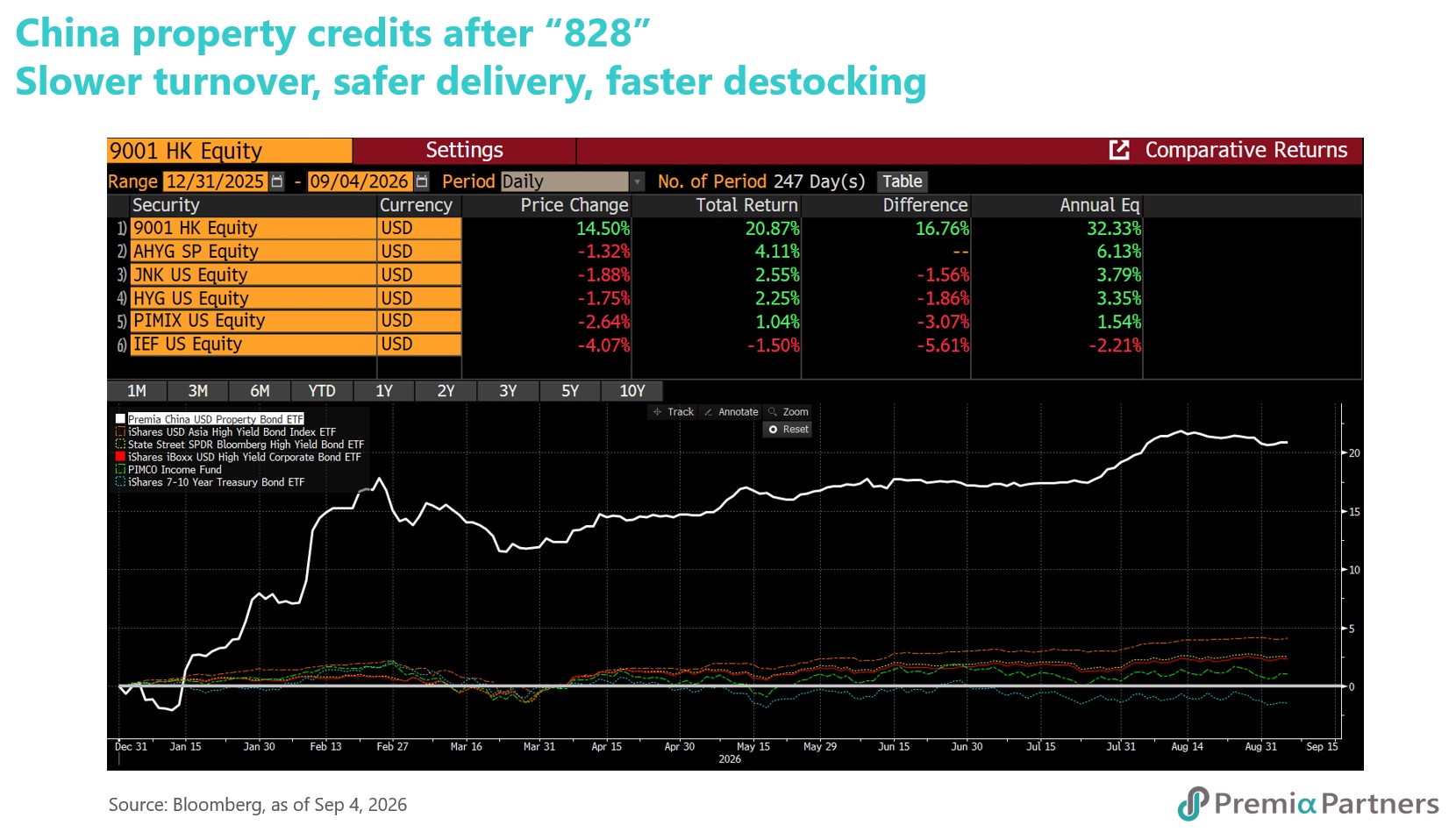
China property USD bonds have extended gains through the third quarter, with the Premia China USD Property Bond ETF (3001/9001 HK) up more than 20% year to date. On 28 August, Beijing announced the most significant overhaul of China's housing sales and financing framework in three decades. It works through four channels:Sales milestones reset. MOHURD, MNR and NFRA now require a building to be structurally topped out before presales can begin, with 100% of purchase funds — down payments and mortgage proceeds — held in supervised escrow until completion and delivery.Lead-bank oversight. Designated banks supervise project financing, escrow and construction progress end to end, and a homebuyer's mortgage is now issued only after the project is completed.Longer mortgage tenors. The PBOC lifted the maximum personal mortgage tenor from 30 to 40 years.Wider capital-market access. The CSRC broadened refinancing and M&A channels, alongside expanded REIT, CMBS and ABS support for income-producing assets.While the near-term read is negative for developers - replacing presale proceeds with borrowing implies higher leverage and more secured debt, which can subordinate existing senior claims - that argues for selection rather than avoidance. The Premia China USD Property Bond ETF (3001 / 9001 HK) holds secured and senior unsecured paper only, and excludes subordinated debt and LGFVs, favouring issuers with recurring rental income and the securitisation access the CSRC has just widened. Over the medium to long term, the reform should reduce the risk of another property-sector shock. Delivery risk moves off household prepayments and into bank-supervised project finance, lowering the odds of a repeat of the unfinished-project stress that drove the last default wave, while tighter new-home supply supports the clearing of existing inventory. Meanwhile, banks are being capitalised to carry that risk: Beijing announced a further RMB360bn (US$54bn) injection into eight state financial institutions on 6 September, of which RMB290bn (US$43.2bn) went to lenders. Brokers expect developer equities to stay soft unless policy surprises or sales data improve. Bonds answer a different question: not whether growth returns, but whether issuers keep paying. The ETF yields around 12.9% (as of Sep 8, 2026), well above the broader Asia high yield market - the extra income investors are paid for the risk that some issuers still restructure or default while the transition plays out.
Sep 10, 2026