精選觀點 & Webinar

AI development between the US and China have taken very different paths. While the US has been prioritizing frontier foundational models, and cutting edge computing power funded by massive private sector capital from global investors, China focuses on taking AI as next generation productivity driver, and emphasizes diffusion, industrial automation, robotics as embodied AI and low-cost open-weight models to drive productivity and economic growth with strong policy influence. This distinction is important in understanding the trajectory of China’s development, and why as investors looking to position for global AI opportunities, the leading cohort in China’s STAR Board where the country’s hard tech leaders converge is increasingly more relevant. In this article, we discuss the background of China’s STAR Board, its leading constituents across China’s emerging hard tech sectors, how the policy tailwinds under China’s 15th Five Year Plan have fast tracked their earnings growth, and the dynamics behind the outperformance of Premia China STAR50 ETF which was up +18% year-to-date compared to offshore China tech which have delivered lacklustre performance as Hang Seng Tech, Overseas China Internet and MSCI China were down between 12-30% during the period.
Oct 07, 2026

Taiwan has emerged as a key beneficiary of the global AI investment cycle, delivering exceptional equity returns while remaining under-owned by international investors notwithstanding the fact that it has already become the largest market within MSCI Emerging Markets. Strong GDP growth, exports and earnings, alongside relatively attractive valuations, provide a solid fundamental backdrop. While TSMC remains the cornerstone of Taiwan’s AI ecosystem, the opportunity extends a broad range of companies spanning foundry, advanced packaging, substrates, networking, power and thermal management, and many are in fact the most leading global manufacturers in critical nodes of the AI and advanced technology supply chain. In this article, our Partner & Co-CIO David Lai discusses such dynamics and drivers behind the outperformance of our Premia FTSE TWSE Taiwan 50 ETF as the tool to capture opportunities in the broader AI value chain opportunities far beyond TSMC alone.
Sep 04, 2026

Onshore Chinese stocks rallied in Q2, as geopolitical anxieties gave way to greater optimism—along with falling energy prices—and AI exuberance continued to support stocks in the global hardware supply chain. Beneath the broad market gains, however, it was a ‘tale of two economies’, as optimism toward tech balanced out a less sanguine view of China’s domestic economy. In this article, Dr. Phillip Wool, Global Head of Research of Rayliant Global Advisors, discusses the macro and factor-level influences of China A share performance in Q2 2026, and given the diversified nature of China’s broad market, it offers a relatively attractive profile for investors in longer-term growth for not only hard tech but broader new economy growth opportunities.
Aug 07, 2026

The Fed's abrupt turn — from rate cuts at the start of the year to a looming hike — has caught many investors off guard. Longer-duration US Treasury strategies have slipped into the red since the war in Iran erupted, as the economy shifted from a supply-side, oil-driven inflation shock to broadening price pressures compounded by a slew of Trump administration policies since 2025. New Fed Chair Kevin Warsh's FOMC has struck a hawkish tone, stripping the market of any lingering hope for a continued easing path. Yet his task is far from straightforward: unlike 2022, this cycle would begin from an already elevated rate plateau rather than near zero — meaning considerable stress is arguably baked into the system before a single hike lands. In this article, we discuss why Floating Rate Notes (3077 / 9077 / 9078 HK) looks increasingly well-timed for investors seeking to derisk by harvesting an elevated, weekly-resetting coupon with effectively zero duration and collecting front-end carry, while longer-duration fixed-rate Treasuries continue to absorb losses at the long end.
Jun 30, 2026
China’s hard-tech sector is entering a new phase of structural growth, driven by AI adoption, semiconductor localization, and strong policy support. Domestic hard-tech leaders across semiconductors, optical networking, advanced manufacturing, and memory technologies have significantly outperformed broader Chinese and offshore equity markets year-to-date, while a new IPO wave led by ChangXin Memory Technologies (CXMT), Unitree Robotics, and other strategic technology champions are set to further enrich the STAR Market ecosystem. In this article, our Partner & Co-CIO David Lai discusses that our Premia China STAR50 ETF and Premia CSI Caixin China New Economy ETF offer targeted access to companies benefiting from China’s long-term technology and industrial transformation.
Jun 12, 2026

The complex macro picture has played squarely to the strengths of Premia's fixed income range, with every ETF in the lineup outperforming its mainstream investment grade (IG) and high-yield (HY) peers over the past six months. On the IG side, a constrained Fed pushing US long-end yields toward 5% makes a strong case to hold shorter duration bonds —while accommodative China liquidity and firm local demand underpinned Asia credit—drove the relative gains than the broader global IG universe. On the high-yield side, the Premia China USD Property Bond ETF significantly outperform the US and Asia HY peers along with the gradual recovery of China's property market, and has more than 660bps of spread still on offer for further compression toward the regional average. In this article, we explore how as this trend persists, the modular lineup offered by Premia's fixed income ETF range is increasingly turning today's fragmented macro environment into clear relative outperformance across both rating tiers.
Jun 12, 2026

Even if a peace deal is achieved soon, the writing is already on the wall for the US economy. Higher inflation and rates/yields appear inevitable. The double shocks of the Trump tariffs of 2025 and now the Iran War will exacerbate the inflation already working its way through the supply chain. In this article, our Senior Advisor Say Boon Lim discusses why as US equity valuations appear increasingly mispriced, with current multiples severely challenged by a rising discount rate, Asian emerging markets are gaining recognition as a resilient alternative. China's exit from deflation is emerging as a positive signal in particular, as improving earnings growth prospects and technological development could together present a compelling alpha opportunity.
May 21, 2026

As Iran conflicts closed off the Strait of Hormuz and sparked the ongoing oil price shock, global equity saw abrupt drawdown in Q1 as geopolitically anxious investors turned risk-off and quickly adjusted portfolios. Amidst that heightened volatility, contrary to broad market correction across both onshore and offshore Chinese equities, the Premia China Bedrock Economy strategy flourished, while the Premia China New Economy and Premia China STAR50 managed to get through the quarter nearly unscathed and remain well-positioned for policy tailwinds and hard tech structural growth as the 15th Five-Year Plan kickstarted. In this article, Dr. Phillip Wool, Global Head of Research of Rayliant Global Advisors, discusses about the macro and factor-level backdrop of China A share performance in Q1 2026, and drivers for continued optimism for onshore equities this year.
May 12, 2026

With US technology stocks under pressure from high valuations and risk-off sentiment from high beta trades amid heightened global market volatilities given geopolitical tensions, China advanced tech sector offers a well-supported and timely alternative for investors looking to diversify. The numbers speak for themselves: over the past two years, the hardcore technology focused STAR50 Index gained 77.3%, comfortably ahead of the Nasdaq's 40.2%. China has put innovation at the core of its long-term growth plan, with strong government backing for AI, semiconductors, and advanced manufacturing. Under Beijing’s domestic substitution policy, Chinese companies are rapidly replacing foreign technology with homegrown solutions, and earnings forecasts are being revised higher. In this article, our Partner & Co-CIO David Lai discusses the policy signals emerging from China's 15th Five-Year Plan and explores how investors can tap into these opportunities through our Premia China STAR50 (3151 / 9151 / 83151 HK) for focused exposure to China's leading hardcore technology companies, as well as our Premia China New Economy (3173 / 9173 HK) that provides broader coverage across nearly 300 holdings spanning the full new economy landscape.
Apr 08, 2026

Last December China launched a major national venture capital fund, a national guidance fund and three large regional funds (Beijing-Tianjin-Hebei, Yangtze River Delta, Greater Bay Area), all designed to channel billions of development capital into "hard technology" sectors like semiconductors, AI, and biomedicine to fast track its trajectory to overcome the current choke points and achieve technology independence amid persistent geopolitical tension. Meanwhile, Bloomberg reported that China is also considering a US$70 billion package of incentives to boost its semiconductor industry. These are only the latest in a string of boosters: China had already announced numerous measures over the past two years, estimated to value almost US$100billion, to lift capabilities in its chip sector. In this article, we reviewed China's ongoing efforts in the global chip race, and how under rapid acceleration in domestic substitution across cutting-edge logic chips, memory foundries, and AI models, our China New Economy (3173 / 9173 HK) and China STAR50 (3151 / 9151 / 83151 HK) strategies are uniquely positioned to capture these structural opportunities.
Apr 08, 2026
Premia 圖說

朱榮熙
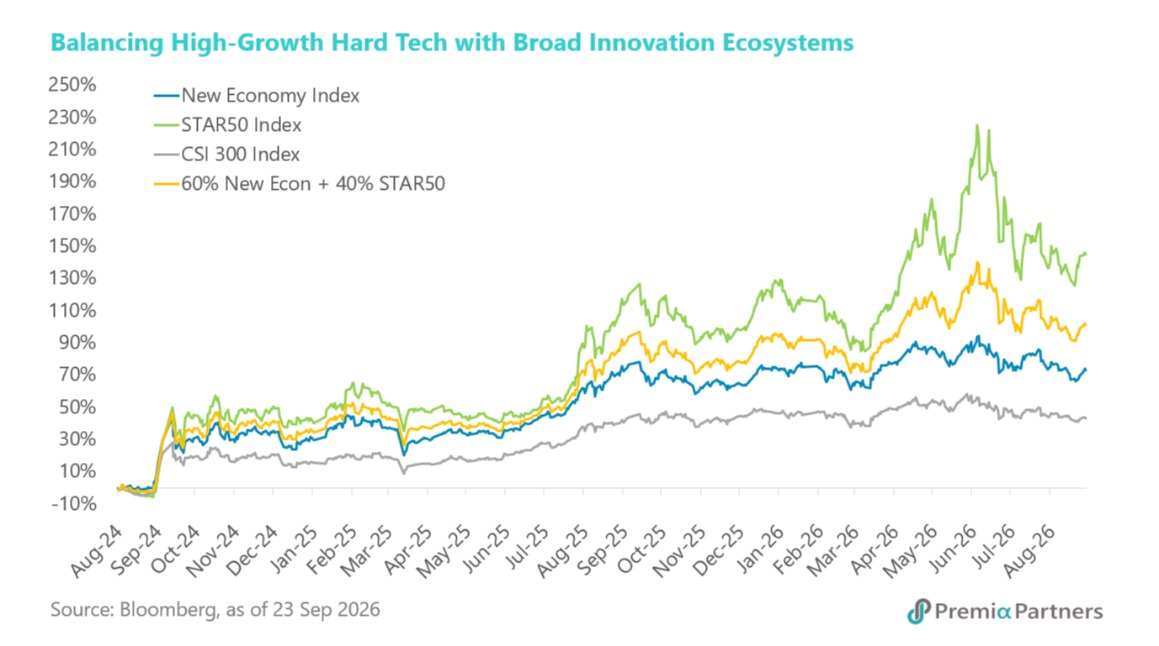
Following the release of the 15th Five-Year Plan outline in March, detailed sector-specific roadmaps are now emerging, placing “new quality productive forces” squarely at the center of China’s long-term growth engine. At the forefront is a strategic push for “full-chain breakthroughs in integrated circuits“ and accelerated domestic replacement. This is supported by massive, coordinated infrastructure commitments: Shanghai and Beijing are aggressively targeting 100,000-card intelligent computing clusters, and the MIIT is mandating the adoption of domestic computing chips. Beyond semiconductors, the 15th Five-Year Plan is sparking a major repricing in Chinese healthcare. Citigroup recently highlighted the plan's core ambition: shifting China from scale-driven manufacturing to global, innovation-driven leadership by 2030, with specific support for AI drug discovery, gene editing, and high-end medical devices. Advances in the domestic AI industry will help the biotech sector achieve critical breakthroughs, which in turn will increase demand for AI infrastructure, creating a powerful positive feedback loop. While the long-term outlook for these strategic sectors is exceptionally bright, the sheer scale of the transition means focusing solely on individual stocks can yield suboptimal risk-adjusted returns. Under these circumstances, utilizing a broad-based ETF to form the core of an investment portfolio—supplemented by individual high-conviction themes—offers a more sustainable approach. Our Premia China STAR50 ETF provides direct, concentrated exposure to the semiconductor and hard-tech leaders building this national AI and space infrastructure. For broader, diversified access across China's entire innovation ecosystem—capturing the synergies between intelligent computing and the booming healthcare sector—consider the Premia China New Economy ETF.
Sep 29, 2026