Intermittent conflict in the Middle East—and the implications for energy prices, inflation and US central bank policy—continued to loom over global stocks during the second quarter, offset by ongoing enthusiasm and positive sentiment toward companies in the hardware supply chain supported by rapid growth in demand for AI compute. Though China officially claimed the title of world’s largest exporter of AI-related tech in April, and despite A shares narrowly outperforming US stocks in Q2, strong earnings expansion among Chinese hardware manufacturers stood in stark contrast to weakness in traditional industries, which still make up the majority of China’s equity market cap, a trend that underscores the “two-speed” nature of China’s economy at present: export-oriented and high-tech industries shine, while the property sector, labor market and domestic consumer demand continue to drag along.
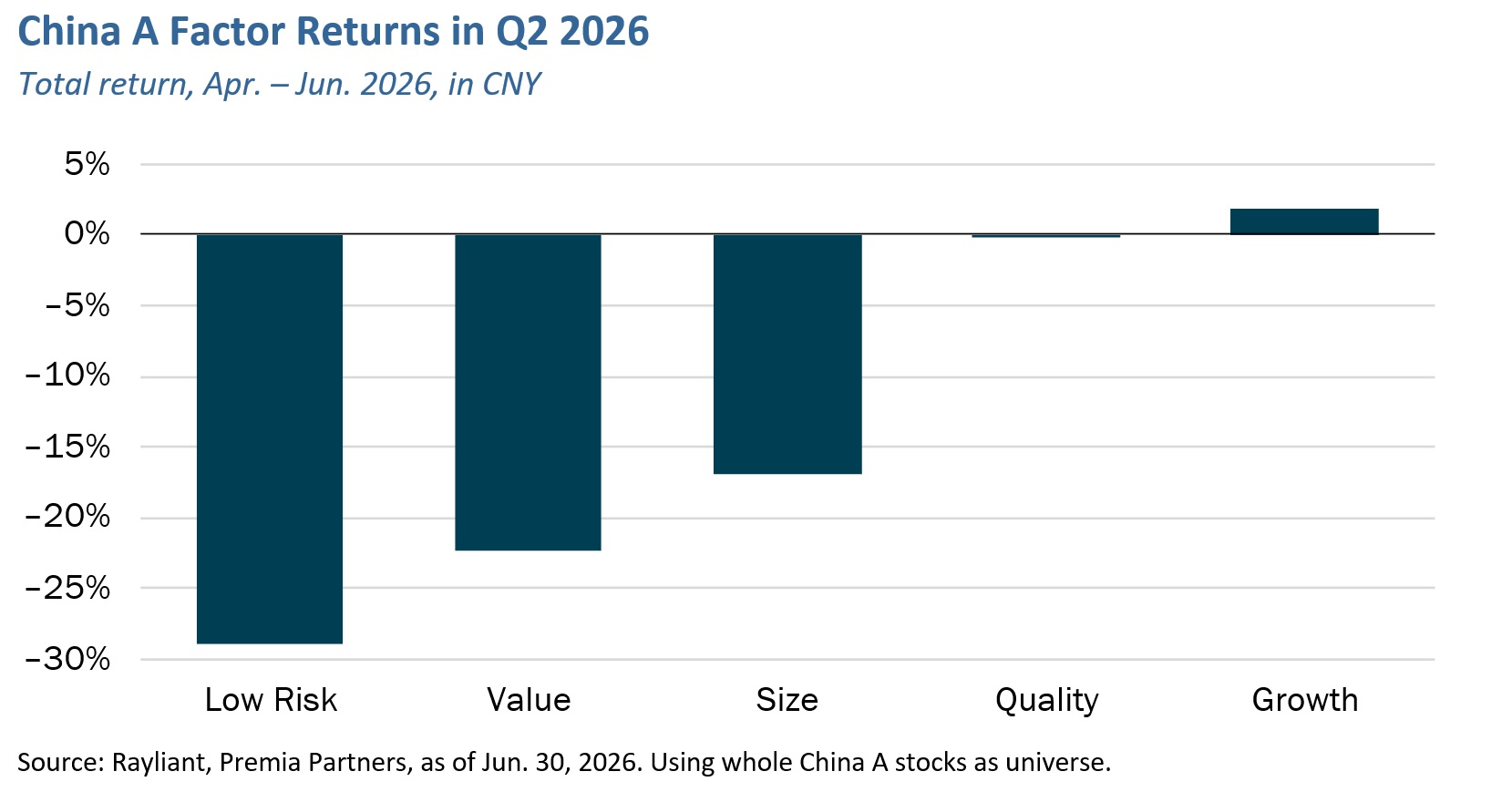
At the factor level, we finally saw a reversal of the last two quarters’ style rotation, which had been favoring defensive factors over more growth-oriented exposures amidst heightened geopolitical uncertainty around the US-Iran conflict. As heavy fighting and surging energy futures gave way to ‘on-again, off-again’ ceasefires and a retreat in oil prices, rebounding equities brought a familiar dynamic: Low Risk and Value tilts—which tend to bet against high-beta stocks and those with sharply rising valuations—registered especially weak performance, while the Growth factor finally delivered a modest positive return, as AI-driven tech plays rallied. The Size factor, which had been performing well in recent quarters, also stumbled in Q2, not least due to soft China macro conditions disproportionately hitting sentiment toward small-caps, which tend to be more exposed to the local economy, relative to mid- and large-cap names.
Comments on Index Performance in Q2
As mentioned above, Chinese equities rallied in the second quarter, propelled by growing optimism in easing geopolitical stress and strength in the AI theme, with the CSI 300 Index finishing the quarter up 12.8% (CNY) over the three months ending June 30th 2026, as shown below. Despite a decidedly hawkish shift in the Fed’s tone during the first FOMC meeting under new chair Kevin Warsh in June, US stocks likewise finished sharply higher in Q2, as the S&P 500 posted a 12.0% (CNY) return, with broader developed markets in the MSCI World Index rising by 12.1% (CNY) for the quarter. The strongest gains, however, accrued to stocks in a broader basket of emerging markets, as the MSCI EM Index climbed a staggering 22.2% (CNY) in Q2, driven largely by Korea and Taiwan—markets with exceptionally large footprints in the AI hardware supply chain.
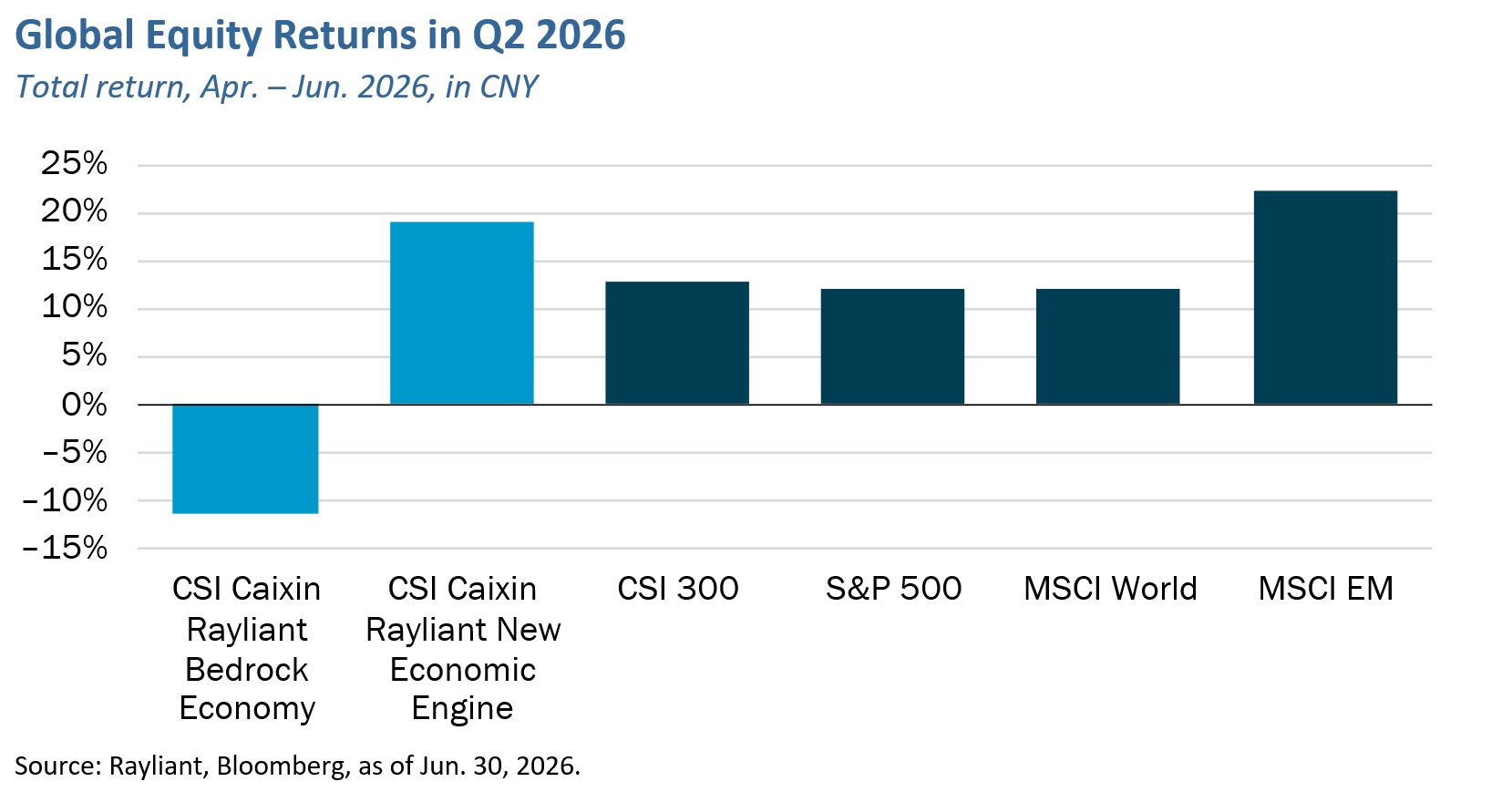
That “two-speed” divergence in China’s economy between old-economy and high-tech segments was on full display in the Bedrock and New Economy strategies performance over the last three months, as the CSI Caixin Rayliant Bedrock Economy Index (tracked by Premia’s 2803 HK/9803 HK ETF) actually declined by 11.3% (CNY), while the CSI Caixin Rayliant New Economic Engine Index (tracked by Premia’s 3173 HK/9173 HK ETF) strongly outperformed the broader market, rallying 18.9% (CNY) in Q2. Tilts toward Value and Low Risk stocks—exposures that had strongly favored the Bedrock strategy last quarter—turned out to be meaningful headwinds over the last few months, while Growth outperformance provided a boost to the New Economy portfolio. Both strategies experienced the drag of a measured tilt toward small-cap stocks as the Size factor underperformed. From a sector standpoint, a vast majority of the Bedrock strategy’s underperformance resulted from allocation effects, including a significant underweight to IT stocks in favor of overweights to Industrials, Financials and Energy shares. The New Economy portfolio’s strongest sector-level alpha, by contrast, resulted from both an overweight to and successful stock-picking within the Materials sector, which benefitted from robust demand for inputs to AI hardware manufacturing.
Bearish observers of China’s economy and markets might be inclined to conclude from action in the second quarter that Chinese stocks’ lagging those in other major emerging markets, like Korea and Taiwan, comes down to structural differences in these markets, for example, the greater weight other East Asian economies have to the tech sector; or from some longer-term downturn in China’s overall economic growth. We believe this assessment is wrong on both fronts, focusing far too much on the short-term noise and missing the bigger picture for China’s beta—not to mention the alpha potential for active investors with intelligent stock selection based on behavioral factor models.
For one thing, divergence between AI-themed stocks and names in less tech-oriented industries is not unique to China’s market, and the hardware-driven rally sending chipmakers’ stocks to record valuations in markets like Korea and Taiwan also leads to overconcentration and the prospect of higher volatility. In that sense, the more diversified nature of China’s broad market offers, in our view, a relatively attractive profile for investors in longer-term New Economy growth. Likewise, we see China policymakers’ push for “higher-quality growth” as a long-term boon for stocks across the market, even if the short-run sentiment favors more explicitly “tech” plays. In the meantime, onshore Chinese shares—especially those in the Bedrock economy without a direct tie to the AI revolution—represent an ideal setting, we believe, for finding medium- to long-term bargains.
*****************************************************************************************************
Dr. Phillip Wool is the Global Head of Research of Rayliant Global Advisors. Phillip conducts research in support of Rayliant’s products, with a focus on quantitative approaches to asset allocation and return predictability within asset classes, as well as the design of equity strategies tailored to emerging markets, including Chinese A shares. Prior to joining Rayliant, Phillip was an assistant professor of Finance at the State University of New York in Buffalo, where he pursued research on quantitative trading strategies and investor behaviour, and taught investment management. Before that, he worked as a research analyst covering alternative investments for Hammond Associates, an institutional fund consultant. Phillip received a BA in economics and a BSBA in finance and accounting from Washington University in St. Louis, and earned his Ph.D. in finance from UCLA, where his research focused on the portfolio holdings and trading activity of mutual fund managers and activist investors. Premia China New Economy ETF and Premia China Bedrock Economy ETF track the CSI Caixin Rayliant New Economic Engine Index and CSI Caixin Rayliant Bedrock Economy Index respectively.