Premia 圖說
Accumulation opportunity in China’s hardcore tech amid market consolidation - Nov 10, 2025

賴子健 , CFA
CFA

Following the Xi–Trump meeting at the recent APEC Summit, market sentiment has turned cautiously optimistic on hopes of a renewed trade truce between China and the US. Some investors, however, view this détente as a sign that China’s drive for technological self-sufficiency could ease. Although the meeting did not address whether Nvidia’s latest Blackwell-series AI chips might be exported to China, speculation has risen that improving relations could lead to a relaxation of export restrictions — a development some perceive as negative for Chinese semiconductor and hardcore tech names. We take a different view. China’s determination to reduce reliance on imported technology remains firm. Recent initiatives, such as the reported requirement for state-funded data centers to adopt domestically produced chips, underscore the government’s resolve to build a self-sustaining semiconductor ecosystem. In mid-October, China Mobile also announced plans to construct the nation’s largest intelligent computing infrastructure by 2028, featuring a “100,000-GPU cluster” that will fully utilize domestic chips. Top Chinese officials have reiterated that innovation and advanced manufacturing remain core national priorities. These developments suggest that even if US export curbs were relaxed, China’s policy direction will continue to favor domestic research, production, and technological substitution. For investors looking to capture this structural growth opportunity, the Premia China STAR50 ETF provides an efficient and diversified vehicle. It offers focused exposure to leading STAR Market companies at the forefront of China’s innovation agenda — from semiconductors and AI to next-generation industrial technologies — positioning investors to benefit from the country’s ongoing technology upgrade.
Vietnam's EM upgrade marks the beginning of a re-rating cycle - Oct 14, 2025

賴子健 , CFA
CFA

Vietnam’s long-awaited upgrade to Emerging Market (EM) status by FTSE Russell marks a pivotal milestone in the evolution of its capital markets. Yet, contrary to the notion that “the good news is already priced in,” history suggests it is far from too late to gain exposure. Past FTSE EM upgrades show that markets tend to continue outperforming well after the announcement—with Pakistan, Kuwait, China A-shares, Romania, and Saudi Arabia outperforming the MSCI EM Index by 66.22%, 28.42%, 20.55%, 15.91%, and 11.11%, respectively, in USD terms during the period from announcement to 12 months post-inclusion. Only Iceland proved an exception at -16.94%. These precedents highlight how structural inflows, valuation re-ratings, and improved investor access typically sustain positive momentum well beyond the initial upgrade news. In Vietnam’s case, the reclassification is just one milestone in a broader reform journey. Ongoing initiatives — including the rollout of a Central Counterparty Clearing (CCP) system, stronger corporate governance, digitalization of market infrastructure, and enhanced foreign access — signal a deepening commitment to transparency, efficiency, and sustainability. As Prime Minister Pham Minh Chinh has reiterated, Vietnam aims to build a market that meets global standards and supports long-term economic growth through efficient capital mobilization. With key reforms still progressing and passive EM fund inflows yet to commence, Vietnam’s re-rating cycle is likely in its early stages. Investors seeking to capture this structural opportunity may consider the Premia Vietnam ETF, which targets mid- to large-cap companies poised to benefit most from Vietnam’s EM inclusion and the ensuing wave of institutional participation.
Vietnam’s consolidation may present an entry point ahead of a potential FTSE upgrade - Sep 29, 2025

朱榮熙
Vietnamese equities have entered a consolidation phase after the VNINDEX briefly touched 1700 points, a record high. This consolidation may offer an attractive entry point ahead of the FTSE emerging market status upgrade, with Vietnam’s finance minster signaling confidence after meeting with FTSE Russell and London Stock Exchange officials in London: “Basically and fundamentally, we have satisfied the criteria of the index providers.” Since summer 2023, Chairwoman Phuong has spearheaded transformative capital market reforms to unlock market access and boost investor confidence, including introducing a Non-Prefunding Model (NPF), implementing a buyback-like mechanism for failed trades, launching the KRX trading platform, enhancing transparency with IFRS reporting and English-language disclosures, removing consular legalization requirements for foreign investors, and establishing an Industry Advisory Group (IAG). FTSE will announce the emerging market upgrade result on October 8th. Vietnam has been seeking the upgrade to "secondary emerging market" status since 2018; analysts estimate that a successful upgrade could drive an extra $5-7 billion of international cash into the country's $350 billion stock market and propel the VNINDEX beyond recent highs. On a longer-term basis, supportive policy measures (such as the government’s target of 8% GDP growth in 2025 and plans to promote private-sector growth) and ongoing corporate earnings improvements (local brokers forecast 14% earnings growth in 2025-26) should provide support on a fundamental level. Amid global market uncertainties, Vietnam offers both diversification and growth opportunities; and our Premia Vietnam ETF is positioned to capture these opportunities and the potential benefits from an EM upgrade.

Increasing interests in A-shares and onshore bonds help drive financial flows - Sep 15, 2025

賴子健 , CFA
CFA

Despite a slower pace of economic growth, international investors are showing renewed appetite for Chinese equities. According to Morgan Stanley, US investor interest in China has climbed to its highest level since 2021, supported by the country’s global leadership in key technology fields such as humanoid robotics and biotech, steady policy steps to stabilize the economy, and clear signs of government support for capital markets. In recent meetings with the bank, over 90% of investors expressed a willingness to raise their China exposure — the strongest conviction since Chinese equities peaked in early 2021. Liquidity conditions have also improved, creating a more supportive environment for equity performance. At the same time, a structural shift is taking shape: for the first time, China’s financial flows have surpassed trade flows, reflecting the rising role of portfolio capital in driving the country’s economic and market dynamics. For global investors, this trend underscores the case for diversification beyond US-centric allocations and into China’s structural growth opportunities. To capture these themes, vehicles such as the Premia CSI Caixin China New Economy ETF, which offers exposure to innovative and consumption-driven sectors, and the Premia China STAR50 ETF, which focuses on China’s leading science and technology champions, provide targeted access to the areas where investor interest is returning most strongly. While short-term growth concerns remain, the combination of policy support, sectoral innovation, and improving capital flow dynamics suggests a more constructive backdrop for long-term participation in China’s equity market.
Structural tailwinds driving the A-share rally - Aug 25, 2025

賴子健 , CFA
CFA

China’s A-share market has broken out since early July, handily outperforming offshore H-shares and global equities. The rally is being fueled by easing geopolitical tensions, Beijing’s “anti-involution” reforms to curb price wars and excess capacity, and renewed risk appetite from both institutional investors and retail flows. Concerns about surging margin financing look overdone. While balances have topped RMB 2.1 trillion, they remain just 1.85% of total market cap — less than half the 2015 peak — signaling leverage is not yet a systemic risk. More importantly, fundamentals are turning decisively supportive:
- Resilient returns – Stable dividends and accelerating buybacks are anchoring valuations, while low bond yields push capital toward equities.
- Underweight positioning – Global investors remain light on China; sustained outperformance could force incremental inflows.
- Attractive valuations – A-shares trade at a ~30% discount to global equities, with the AH premium near five-year lows.
- Policy visibility – The upcoming Fourth Plenum is expected to reaffirm Beijing’s pro-growth stance and set the tone for the next Five-Year Plan.
- Currency stability – The RMB looks steady with upside bias, reinforcing investor confidence.
Together, these dynamics suggest the rally is more than a short-term bounce — it’s the start of a re-rating story supported by policy, positioning, and valuations.
EM ASEAN equities are set to catch up - Jul 28, 2025

朱榮熙

Emerging ASEAN equities have underperformed compared to other emerging markets, but they have the potential to catch up due to improved US tariff rates, increased foreign investment, and more relaxed monetary policies. Vietnam was among the first to secure a trade deal with the US, establishing a reciprocal tariff of 20%. Since the announcement, Vietnamese equities have rallied, outperforming the emerging market index. Similarly, Indonesia and the Philippines have both secured 19% tariff deals in later stages, with Indonesia already showing market improvements and the Philippines expected to follow suit. Thailand is actively negotiating with US trade officials to reduce its current 36% tariff, with potential progress expected before the August 1 deadline. If other emerging ASEAN markets follow Vietnam’s lead, the overall equities index could recover the 17% year-to-date underperformance. Foreign investors are pouring into the region, with Vietnam experiencing a surge in inflows. Thailand’s equities market is also attracting foreign interest, driven by improved sentiment ahead of the central bank governor nomination, who supports more relaxed policies. Amid lower tariff uncertainties and a weaker USD, ASEAN central banks are focusing on growth risks, with room to lower interest rates to support the economy. Recently, Bank Indonesia surprising many economists with a 25 bps policy rate cut. With lower tariffs, returning foreign investors, and eased local policies, Emerging ASEAN equities could gain momentum. To capitalize on these shifts, investors can consider our Premia Dow Jones Emerging ASEAN Titans 100 ETF, offering strategic exposure to the region’s growth dynamics. Additionally, the ETF has announced a record dividend payout of USD 0.43, yielding 4.8%, reflecting consistent dividend improvements from the underlying and providing investors with extra protection.
Chinese SOEs may be worth revisiting - Jun 16, 2025

朱榮熙

Chinese state-owned enterprises (SOEs) may gain traction again amid Chinese government’s commitment to stabilize the capital market, market value management implementation, and attractive yield against the government bonds. Central Huijin, often considered to be the national team, is approved by CSRC to be the new controlling shareholders of 8 small to mid-size financial companies, with an aim to stabilize the capital market and mitigate potential risks. Investors are also anticipating further policy support for the financial sector, expected to be announced at the Lujiazui Forum in Shanghai. This led to the strong capital inflow to nonbanking financials and outperformance of the sector. Moreover, a couple of SOEs have revealed their market value management plans or valuation improvement plans. Local brokers believed this trend will continue and gain momentum in the rest of this year, leading to the revaluation of these SOEs. On the short-term yield, China’s one- and three-year bonds fell to a four-month low due to heavy purchases of state banks. Onshore traders speculated that the PBOC was involved in the purchases. The PBOC’s potential purchases is one of the tools to bring liquidity to the market. As the bond yield drops and liquidity increases, the relatively higher SOE’s dividend yield would look appealing to investors, further supporting their share prices. To capitalize the above trend and diversify from growth related stocks, investors may consider our Premia CSI Caixin China Bedrock Economy ETF, which places a significant emphasis on SOEs, accounting for over 70% of its portfolio, benefiting from the government support and the potential high dividend yield.
Foreign interest in China's bond market remains strong - May 26, 2025

賴子健 , CFA
CFA

Foreign interests in China’s bond market shown sustained growth, with foreign institutions holding over RMB4.44tn in Chinese bonds by the end of Apr. This marks the third consecutive month of increased foreign investment, signaling confidence in the country’s financial stability. Notably, China government bonds (CGBs) comprised the largest portion of these holdings—RMB2.11tn or 47.5%—demonstrating their appeal as secure and attractive assets. The improving sentiment is underscored by the continued rise in demand for renminbi assets. In Apr alone, foreign investors added a net US$10.9bn to their holdings of domestic bonds. Despite a modest foreign exchange deficit, China’s overall foreign exchange market has remained stable, supported by a strong trade surplus in goods, which hit a four-month high of US$31.6bn. Further bolstering investor confidence, Chinese banks are expected to see a periodic surplus in foreign exchange sales, aided by supportive monetary policies such as interest rate and reserve requirement ratio cuts. Progress in high-level Sino-US trade negotiations and a temporary easing of tariffs also contribute to a more favorable investment climate. The growing foreign appetite for CGBs highlights their strength as stable, long-term assets. Backed by strong macroeconomic fundamentals and improving trade dynamics, China’s bond market continues to present attractive opportunities for global investors seeking diversification and steady returns.
A constructive outlook on China's housing market - Apr 28, 2025

賴子健 , CFA
CFA

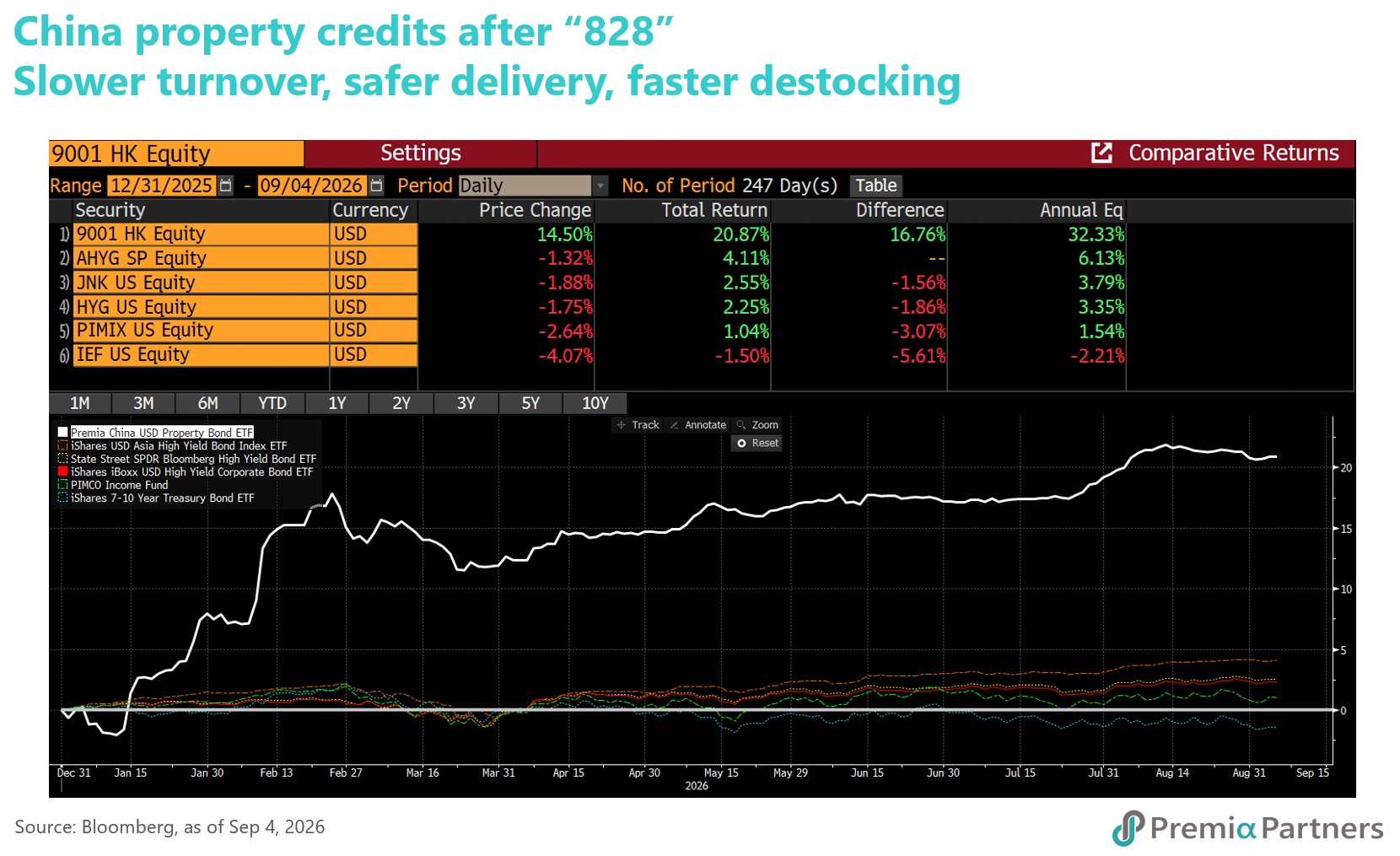
An increasing number of analysts are reaffirming a constructive outlook on China’s housing market, as supportive policies help shift the narrative from crisis to structural recovery. According to HSBC, a combination of factors—including supply constraints, credit normalization, and policy convergence—is driving a turnaround in the property sector. The average home mortgage rate has dropped to a record low of 3.1%, down significantly from 5.6% in 2021. In Q1 2025, rental yields exceeded mortgage rates in 42 out of 129 major cities, compared to just 12 cities a year earlier, resulting in a positive cost of carry. Additionally, household mortgage burdens have eased, with the mortgage-to-income ratio falling to 42%—a decade low—from 57% in 2021. For developers, funding costs are also at record lows. State-owned enterprise (SOE) operators now face average borrowing costs of 3.46%, with some construction loans as low as 1.8%. This sharp reduction in interest expenses is helping restore profitability, ensure project completion, and free up capital for land acquisition. On the inventory front, 14 cities saw over a 20% drop in housing stock between April 2024 and March 2025, with Shenzhen’s inventory hitting a three-year low. Meanwhile, the offshore bond market is beginning to reopen for quality issuers facing near-term dollar bond maturities. For instance, Greentown China and Beijing Capital Land successfully returned to the primary market in March, raising a combined US$1.45 billion—breaking a two-year issuance drought. Investors seeking exposure to this segment can consider the Premia China USD Property Bond ETF, which has delivered a solid 8.9% return year-to-date.
Asia credits may carry on their outperformance - Apr 07, 2025

賴子健 , CFA
CFA

With US trade policy still in flux, markets are grappling to assess its immediate impact on credit profiles and spreads. In this context, Asia’s investment-grade (IG) dollar bonds appear well-positioned. Despite many regional economies running substantial current account surpluses with the US, companies issuing in the offshore USD bond market are typically less exposed to this trade dynamic. Analysts suggest the intensifying trade war could see 10-year US Treasury yields fall towards 3.5%, with US credit spreads likely to widen by the end of the year. While this would put pressure on Asian credit spreads, investors need not adopt an overly bearish outlook. The relatively high headline yields provide a useful buffer against mark-to-market volatility. According to HSBC estimates, Asia’s credit market would only face losses if headline yields rise above 6% by year-end, a scenario requiring both wider spreads and a sharp increase in Treasury yields — a combination unlikely unless the US experiences stagflation. If the decline of American exceptionalism persists, it will disproportionately affect US assets. On the other hand, Asia’s credit market benefits from several key advantages: shorter spread duration, robust regional investor demand, and a lower beta issuer profile compared to other emerging markets. These factors suggest that excess returns in Asia’s IG dollar bonds will likely continue to outperform their global peers.