featured insights & webinar

2019 saw expensive asset classes get more expensive, a global yield back-up replaced by a yield rally, continued outperformance of DM over EM and Growth over Value (notwithstanding a few wobbles). As we approach 2020, we review market behavior during the last 12 months, the risk and opportunities going forward and make a few observations about trends that will dictate returns.
Dec 09, 2019
We review the history of Chinese consumption over the last 30-40 years and explain why we believe the Chinese consumer holds the key to global economic growth, not just in China but in every country connected to international markets.
Nov 11, 2019
Investors like to conceptualize mega trends into investment themes, which fund managers use to identify strong companies based on top-down investment approaches with a focus on broader, macroeconomic themes. New investment themes always emerge from time to time, such as dot.com around the millennium, social media & robotics in the past decade, or sharing economy & artificial intelligence not long ago. What do they have in common? Technology! A sudden shift in technology would make transformative changes that redefine work processes, rewrite the rules of competitive economic advantage, and eventually the structural breakthrough will bring the potential output to the next level. That’s why market is interested to find out if 5G is a crucial investment theme.
Nov 05, 2019
“Think about what is happening worldwide right now. The US is dragging down global growth by attempting to impose trade tariffs everywhere, China is facing a major economic slowdown, Japan continues their third “lost-decade”, Germany is heading into recession, and the UK is still debating with EU about the way of Brexit. These are just the highlights of how the top five economies are doing, not even mentioning the more troublesome territories such as Italy and Argentina which may have to deal with their escalating debt problems. These markets accounted for more than 70%-80% of the global stock markets depending on which particularly benchmark one is using to measure against the performance. The issue gets more complicated when the US market, weighting over 50% in most clients’ equity portfolio, seems to be exhausted after recording the longest bull run in history whilst still hovers at all-time high. The most imminent question among investors is where to find the peace in the midst of the storm.”
Oct 22, 2019
The US-China trade dispute rumbled and concerns over global growth continued to mount in Q3. Factor-wise, Quality continued to outperform while Value is trailing, badly. Overall, the China A-shares ended roughly flat in Q3, and it was a meaningful quarter to the market with MSCI, FTSE, and S&P Dow Jones all made announcements of (further) inclusion of China A-shares into their benchmarks. Heading into Q4, we believe “Megatrends” continue to be the key investment themes and “Diversification” core to portfolio risk management. We don’t see a Value trap environment, but the comeback relies on many catalysts amid the current market uncertainties. Consolidation will happen as China rebalances to a “new normal”, and we believe Quality Growth is the best approach to capture domestic champions.
Oct 21, 2019
When over 30% of the investment-grade bonds are selling at a negative yield, the longest bull market in the US seems to be wobbling, global growth is decelerating and the two biggest economies are in a dispute over trade and technology, there is a need for most investors to anchor themselves in a stronghold to face the volatile markets. Benjamin Graham’s Intelligent Investor, often referenced as the best book on investing ever written, may be able to offer a bit of insight for us. At the end of the day, an intelligent investor is a realist who sells to optimists and buys from pessimists. The author has experience to back it up: Graham's personal losses in the 1929 crash and the Great Depression led him to perfect his investment techniques.
Oct 18, 2019
Forget about Donald Trump – this is what the markets are really worried about. Forget about the Trump Impeachment. That’s a sideshow. It will get sordid but Democrats won’t get rid of Donald Trump without the support of two-thirds of the Senate. That’s unlikely to happen, given currently available information about the President’s activities. At most, the impeachment inquiry will contribute to the political point-scoring of the 2020 Presidential Election. The greater decision facing investors now is whether they are prepared to put more money down on renewed quantitative easing in Europe and eventually the United States – a phenomena that will simultaneously feed asset markets and distort resource allocation around the world.
Oct 03, 2019
What’s behind China A-shares recent rally? Why are new economy stocks seemingly in the lead after more than 3 years of underperformance?
Sep 18, 2019
Looking for a high conviction basket of Asia growth opportunities? We have a solution for you! Premia Asia Innovative Technology is a diversified, transparent, cost-efficient strategy capturing 50 Asia innovation leaders, and it is a basket of stocks favoured not only by analyst consensus but also many long-term investors including leading sovereign funds and private equity firms. Apart from the well-known BATJs, this vibrant region is also home to many other innovative companies such as the new e-commerce disruptor Pinduoduo and the photon technology evergreen Hamamatsu.
Sep 05, 2019
Market has been focusing on the export side of Vietnam and how it will benefit from the trade war in the past few months. Of course, that is happening and more foreign companies from garments, furniture, packaging to electronics are setting up their factories in Ho Chi Minh, Honai, Bac Ninh, Thai Nguyen, etc. We, however, think it is worthwhile to consider another side of the growth story here: domestic consumption. The continuing economic growth, rising of middle class, and increasing urbanization will all help consumption to grow significantly in Vietnam ahead.
Aug 26, 2019
BY TOPICS
Chart Of the Week

Michael Ng
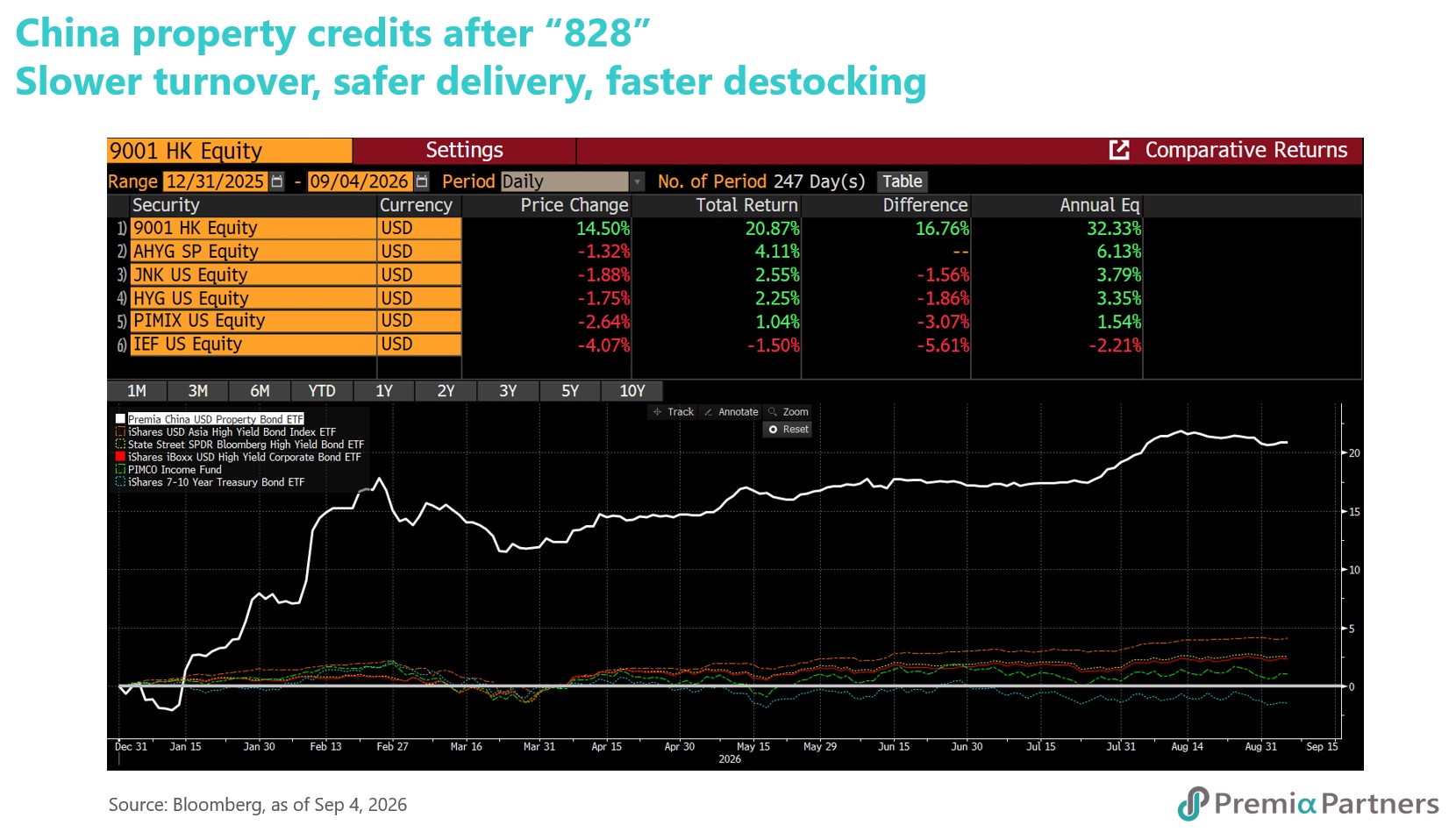
China property USD bonds have extended gains through the third quarter, with the Premia China USD Property Bond ETF (3001/9001 HK) up more than 20% year to date. On 28 August, Beijing announced the most significant overhaul of China's housing sales and financing framework in three decades. It works through four channels:Sales milestones reset. MOHURD, MNR and NFRA now require a building to be structurally topped out before presales can begin, with 100% of purchase funds — down payments and mortgage proceeds — held in supervised escrow until completion and delivery.Lead-bank oversight. Designated banks supervise project financing, escrow and construction progress end to end, and a homebuyer's mortgage is now issued only after the project is completed.Longer mortgage tenors. The PBOC lifted the maximum personal mortgage tenor from 30 to 40 years.Wider capital-market access. The CSRC broadened refinancing and M&A channels, alongside expanded REIT, CMBS and ABS support for income-producing assets.While the near-term read is negative for developers - replacing presale proceeds with borrowing implies higher leverage and more secured debt, which can subordinate existing senior claims - that argues for selection rather than avoidance. The Premia China USD Property Bond ETF (3001 / 9001 HK) holds secured and senior unsecured paper only, and excludes subordinated debt and LGFVs, favouring issuers with recurring rental income and the securitisation access the CSRC has just widened. Over the medium to long term, the reform should reduce the risk of another property-sector shock. Delivery risk moves off household prepayments and into bank-supervised project finance, lowering the odds of a repeat of the unfinished-project stress that drove the last default wave, while tighter new-home supply supports the clearing of existing inventory. Meanwhile, banks are being capitalised to carry that risk: Beijing announced a further RMB360bn (US$54bn) injection into eight state financial institutions on 6 September, of which RMB290bn (US$43.2bn) went to lenders. Brokers expect developer equities to stay soft unless policy surprises or sales data improve. Bonds answer a different question: not whether growth returns, but whether issuers keep paying. The ETF yields around 12.9% (as of Sep 8, 2026), well above the broader Asia high yield market - the extra income investors are paid for the risk that some issuers still restructure or default while the transition plays out.
Sep 10, 2026