The consolidation in China’s new economy stocks has created an attractive entry point for investors willing to look beyond near-term sentiment. Its top holding CATL’s A-shares has corrected roughly 35% since their early May peak amid the “de-CATLization” trade, while the CSI Caixin Rayliant New Economic Engine Index tracked by the Premia China New Economy ETF dropped 12% over the same period. This market concern appears increasingly disconnected from underlying fundamentals and underestimated the importance of scale, technology execution, product quality, consumer trust and financial resilience, where CATL remains structurally differentiated and dominates. With first-half net profit rose 42%, energy-storage revenue jumped 87.5%, CATL expanded its share of China’s passenger EV battery market despite broader supplier diversification. Beyond CATL, China’s biotech sector also emerged stronger over past decade, and the stream of global licensing deals in recent years are validating China’s biotech innovation, and AI-related demand and domestic substitution policies are fast tracking China’s development of domestic semiconductor and physical AI supply chain. With valuations reset across China’s new economy sector, current levels offer a clear opportunity to accumulate exposure to established industry leaders and emerging growth engines at a discount.
The flawed logic behind the “de-CATLization” trade
The “de-CATLization” narrative has gained traction as automakers broaden their battery supplier base and develop in-house capabilities, yet diversification has not translated into permanent market-share erosion for the incumbent. CATL’s share of China’s passenger EV battery market rose 0.4 percentage point year-on-year to 43.1% in the first eight months of 2026. This resilience is visible at the customer level: after CATL’s share at Nio fell to 60% in 2025 following CALB’s introduction, it recovered to 77% in the first eight months of 2026. CATL has also regained share at Geely and expanded meaningfully at Leapmotor. Despite new supplier nominations capture headlines, execution reality reflects sustained automaker reliance on CATL's superior product reliability. In fact, it appeared many switched back to CATL after initial attempts of switching to alternative brands.
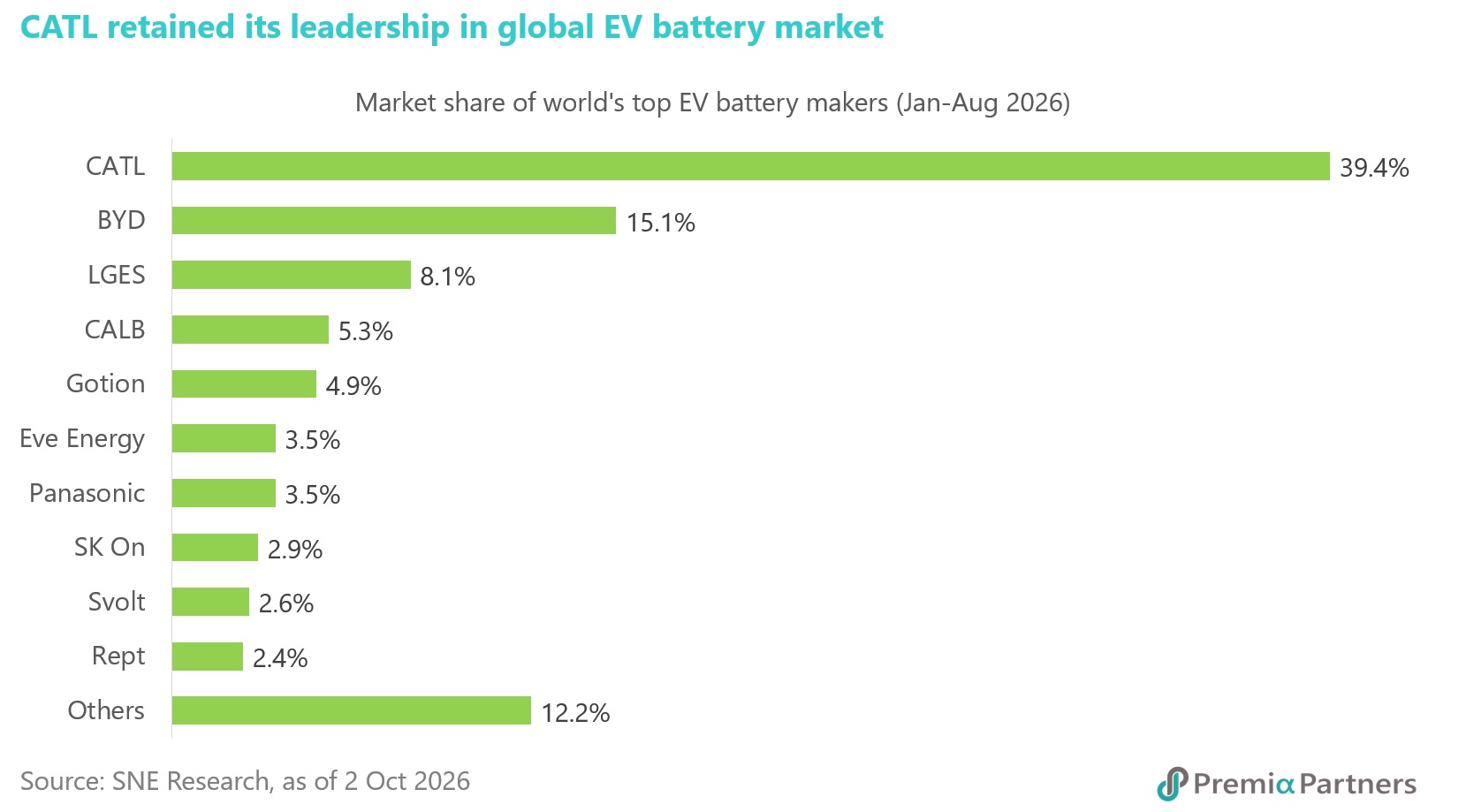
These competitive advantages become structural when viewed in a global context. CATL shipped more than 660GWh in 2025, compared with around 40-120GWh for second-tier suppliers and sub-10GWh for most automaker-affiliated operations. This lead widened further into the first eight months of 2026, with its global EV battery market share increasing 2.6 percentage points year on year to 39.4%. Ultimately, this unmatched scale yields a compounding loop as it drives superior procurement advantages and optimized utilization. At the same time, it generates the vast field-performance datasets required to continuously refine battery degradation and safety parameters.
As second-tier suppliers narrow the performance gap in conventional Lithium Iron Phosphate (LFP) energy density and fast-charging, the competition frontier is shifting towards manufacturing consistency, lifecycle degradation and long-term product safety. These distinctive features for high performing batteries often are also marketed as key differentiated features for Chinese EVs in a market already under intense price competition, and EV makers all try to differentiate to sustain market share in higher margin segments. This is especially important for those eyeing the export markets where safety and performance features are key focuses. CATL’s scale, manufacturing expertise and vast field data provide a formidable advantage here. Furthermore, its 76% share of China’s premium NCM (Nickel (Ni), Cobalt (Co), and Manganese) battery market, alongside its leadership in semi-solid-state batteries, cements its technological edge even as commoditized specifications normalize across the industry.
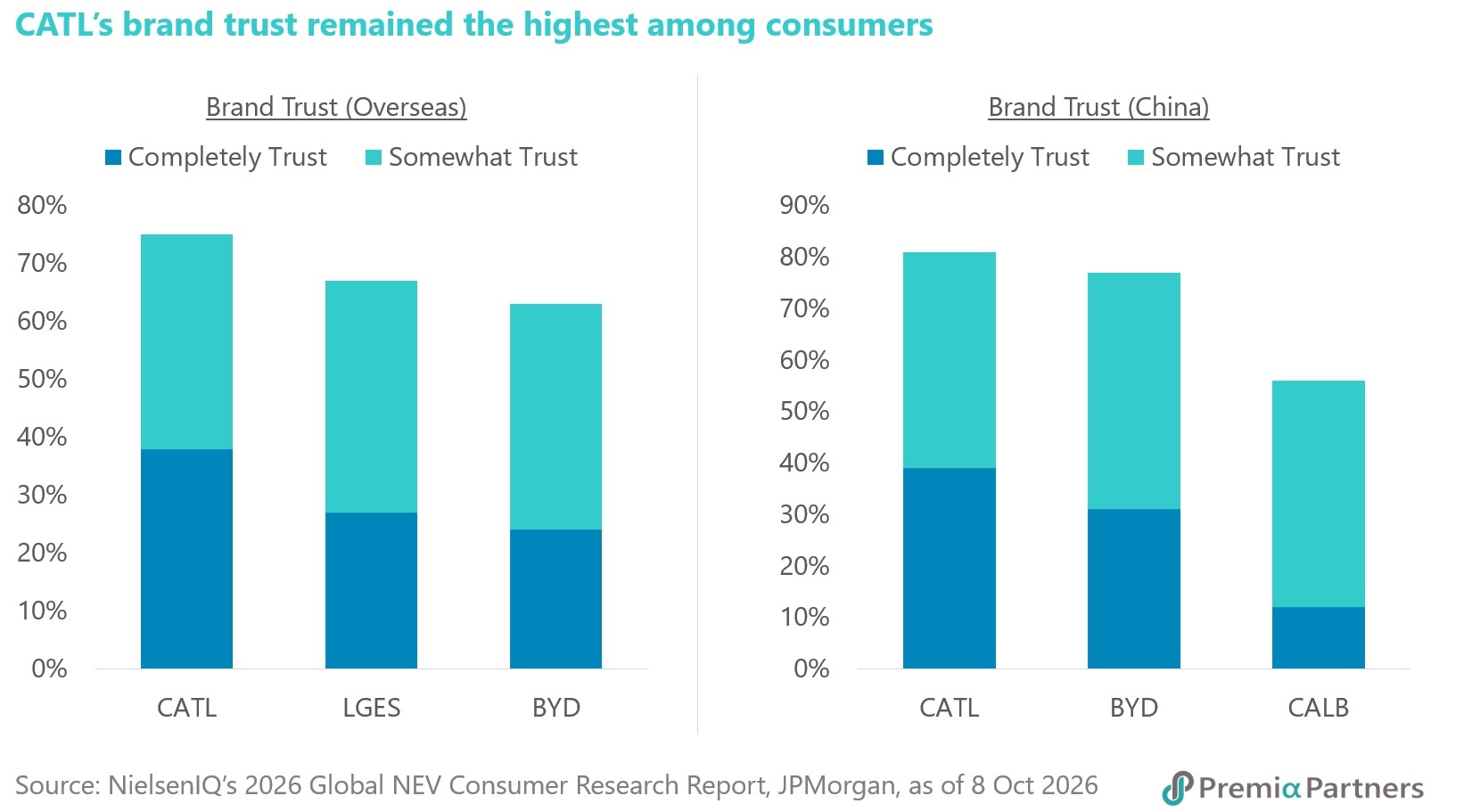
Crucially, CATL also commands an advantage in consumer brand awareness. Research cited by JPMorgan from NielsenIQ’s 2026 global NEV survey found that 79% of consumers said a well-known battery brand would increase purchase intention and 76% would pay a premium for verified quality. CATL ranked first in battery-brand awareness and trust in China and overseas markets. As buyers look closer at safety profiles and vehicle resale value, this market reputation gives automakers a powerful commercial incentive to maintain CATL inside their vehicles. The combination of industrial scale, premium technology, and brand equity creates a defensive moat for more resilient than the de-CATLization narrative suggests.
Multiple growth engines beyond EV batteries
CATL’s expansion is increasingly diversifying outside of EV, with the energy storage system (ESS) business emerging as a major second earnings engine. First-half ESS revenue rose 87.5% to RMB53.3 billion, accounting for 19.2% of group revenue and yielding a 23.9% gross margin that outpaces the 20.6% recorded for EV batteries. This growth tracks global renewable energy capacity expansions, which require massive storage installations to balance intermittent generation and stabilize grids. Over the longer term, management targets an aggressive mix shift, projecting that the energy storage system (ESS) business will expand to account for half of global sales within five years. Domestically, Beijing's mandate for non-fossil energy to reach 25% of total consumption by 2030 serves as a structural catalyst, unlocking immediate scale amid heavy national grid investments.
Meanwhile CATL partners with Shanghai Jiao Tong University / Future Energy Research Institute to co-develop bionic and industrial robots alongside CATL’s internal Shanghai-based robotics team (which also develops robotic arms and AGVs). CATL also works with several robotics companies and embodied-intelligence startups to integrate AI humanoid and industrial robots into its battery manufacturing plants and with battery designs appropriate for robotics use cases. For instance, it signed a global strategic cooperation agreement with Galbot to deploy the heavy-duty Galbot S1 humanoid robot across CATL’s smart production lines for material handling, picking and module assembly. The Galbot S1 is powered by CATL's own batteries. CATL also works with Spirit AI, a Hangzhou-based robotics startup backed by CATL that developed "Moz" (Xiaomo), a humanoid robot utilizing Vision-Language-Action (VLA) models to handle high-precision assembly tasks like high-voltage connector insertion. Auto-focused Horizon Robotics also partnered with CATL’s smart technology subsidiary, Contemporary Amperex Intelligence Technology (Shanghai) Limited (CAIT-SH), to integrate intelligent driving, chassis hardware and smart energy solutions.
Complementary growth paths are also developing via charging infrastructure, battery swapping, and next-generation chemistry. The third-generation Shenxing battery anchors their ultra-fast charging strategy, while the proprietary Choco-Swap network has expanded to 2,520 stations across 200 cities. This integrated ecosystem approach creates commercial advantages that extend well past simple cell manufacturing. On the technology front, CATL has brought its Naxtra sodium-ion battery to GWh-level industrialization, targeting full-scale production by the end of 2026. A three-year, 60GWh supply agreement with energy-storage integrator HyperStrong secures an immediate route to market, reinforcing CATL’s track record as a first-mover capable of commercializing new technologies ahead of its peers.
CATL’s sell-off in the past few months reflects anxieties over intensifying competition, but the market may be underestimating the durability of its competitive advantages and the breadth of its secular growth drivers. The stock trades at a 12-month forward PE multiple of just 11.5x, a deep discount given a projected EPS growth above 20% and an ROE exceeding 25%. Backed by a free-cash-flow yield near 10% and a total shareholder yield of 5–6%, this combination of robust earnings growth, cash generation and capital returns suggests that the shares are priced for a far worse operational outcome than fundamentals imply. The recent weakness, therefore, represents a severe valuation compression rather than a reversal of CATL’s long-term growth trajectory.
Biotech and AI hardware: Additional tailwinds across the new economy basket
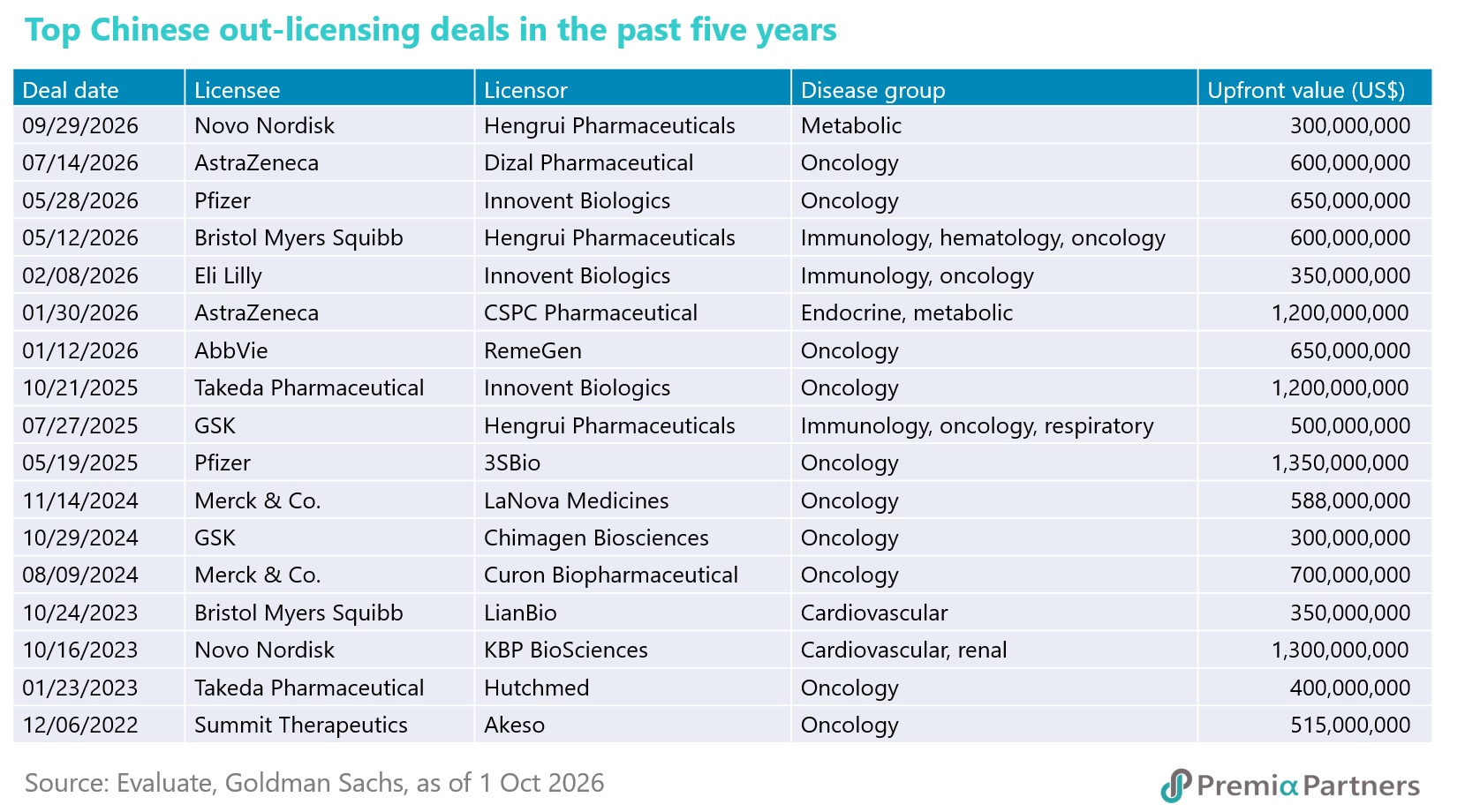
The opportunities within the new economy are not limited to battery manufacturing. In biotechnology, a surge in global licensing deals provides clear evidence that China’s drug developers can successfully monetize their R&D pipelines on the world stage. Novo Nordisk’s agreement for Jiangsu Hengrui’s oral GLP-1/GIP candidate included US$300 million upfront with up to US$2.6 billion in potential payments, while AstraZeneca’s licensing deal for Dizal’s lung-cancer drug sunvozertinib was worth US$600 million upfront alongside up to a further US$900 million in milestone payments. This fundamental momentum is mirrored by contract research, development and manufacturing organizations (CRDMOs) like WuXi AppTec, which recorded an impressive 38.9% first-half revenue increase to RMB28.9 billion. These two sub-sectors offer exposure to different stages of the innovation cycle, from early-stage discovery to commercial partnerships.
A similar expansion is playing out in AI infrastructure, where accelerating demand and China’s push for semiconductor self-sufficiency are creating opportunities across the supply chain. Riding this wave of localized silicon demand, fabless chip designer GigaDevice reported first-half net profit jump almost elevenfold, benefiting from tight memory supply and higher prices. Supporting this surge in domestic chip architecture, semiconductor equipment maker AMEC saw its earnings rising about 300% on strong factory orders, although investment gains also contributed to the gains. Further along the value chain, memory-interface developer Montage Technology and optical component supplier Suzhou TFC Optical reporting first-half net profit growth of 72% and 34%, respectively.
Alongside CATL, these selective holdings just demonstrate different key innovation-driven growth engines within the new economy sectors, from energy transition, biotechnology and semiconductor localization. By diversifying away from any single company or technology, a broader framework allows investors to participate in the secular trends powering China’s next economic cycle.
Using Premia China New Economy ETF to capture the next growth cycle
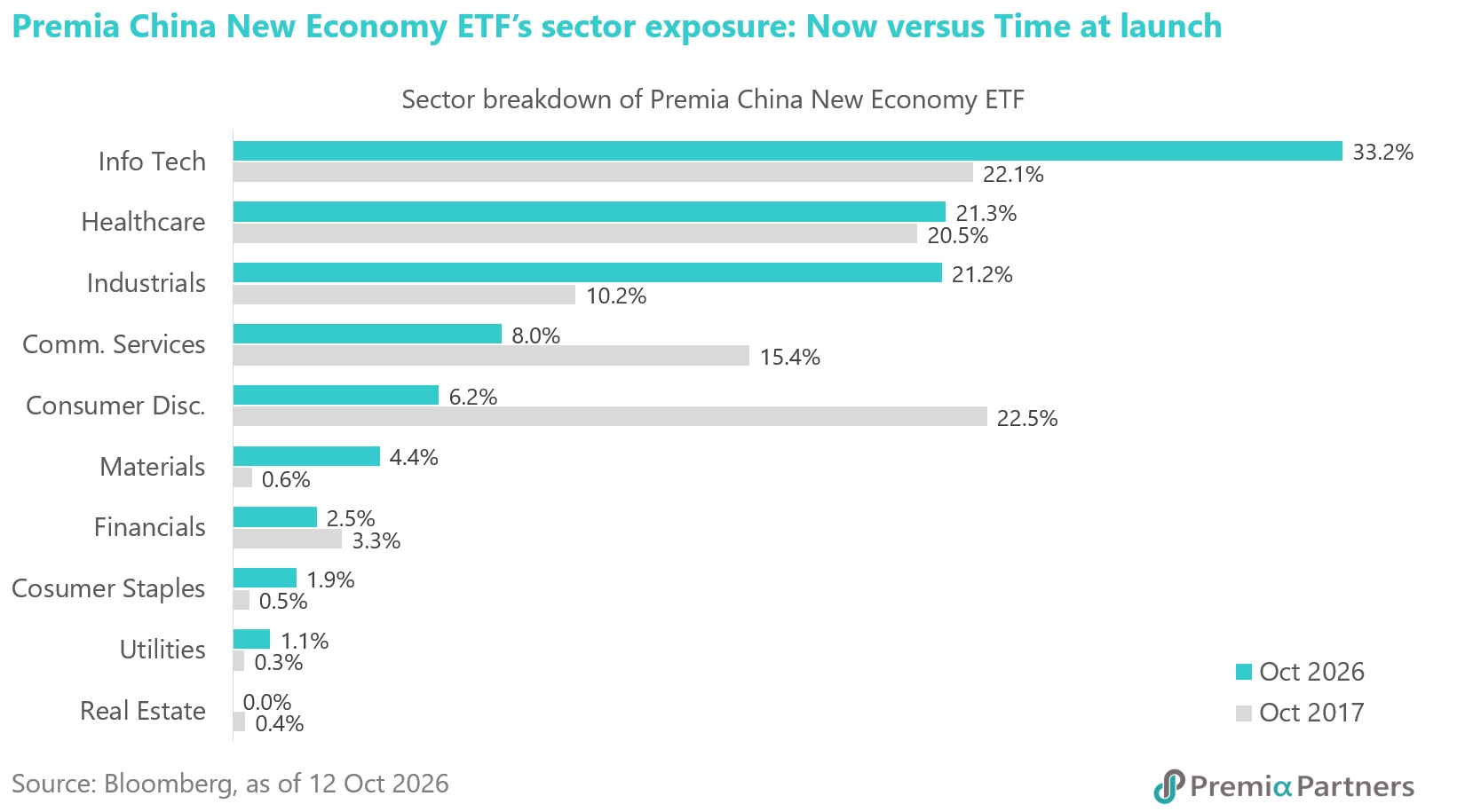
The Premia China New Economy ETF, tracking the CSI Caixin Rayliant New Economic Engine Index, provides a well-balanced allocation across ~300 China A-share companies. The index has shifted alongside China’s changing growth priorities. When the ETF launched in October 2017, consumer discretionary was its largest sector exposure, with Gree Electric, SAIC Motor and Haier Smart Home among its top holdings, reflecting the policy focus on “consumption upgrades” at the time. Today, consumer discretionary has dropped to the fifth-largest sector position, carrying only a single-digit weight. This structural flexibility is central to the strategy, enabling the index to adapt as China’s economy develops and new industries become the engines of growth.
China’s 15th Five-Year Plan explicitly identifies embodied intelligence, 6G, quantum technology, hydrogen, and nuclear fusion among its future industries. Although many of these sectors remain at an early stage with few listed companies offering a direct play today, the index is built to evolve alongside the changing opportunity set. This allows investors to capture companies positioned to benefit from China’s changing growth engines without having to identify individual winners in advance.
The ETF currently trades at a 12-month PE multiple of 19.0x, sitting below its five-year average of 21.3x. Against a backdrop of resilient earnings in key holdings, structural growth opportunities throughout a diversified basket of close to 300 leading new economy sector players across China’s main boards and STAR board, and a more attractive valuation starting point, the recent pullback offers investors an opportunity to accumulate positions during this market weakness.