Premia 觀點洞察
精選觀點 & Webinar

A quick review of what MSCI did and didn't do, its impact, why it matters and how investors should approach China going forward.
Jun 22, 2017
Our advisor, Dr. Jason Hsu, recently did a podcast with Meb Faber (co-founder and CIO of Cambria Investment Management) on China opportunities, investors' preference for complexity over simplicity, and key takeaways for investors implementing smart beta strategies in China.
Jun 07, 2017
This morning Bloomberg ran a story about LeEco, a Chinese technology conglomerate that has been growing rapidly until recently.
May 23, 2017
Are all smart beta products smart? This is a question I've asked a few times over the last few years but always got a "nuanced" answer depending on the product being marketed.
May 14, 2017
Can you trust the numbers reported by all Chinese listed corporations? Absolutely not. But that doesn't mean smart beta can't generate alpha. With help from our friends at Rayliant, we dive into a factor metric that allows us to deprioritize earnings manipulators and to generate alpha from their efforts.
Jan 16, 2017
Premia 圖說

吳偉鋒
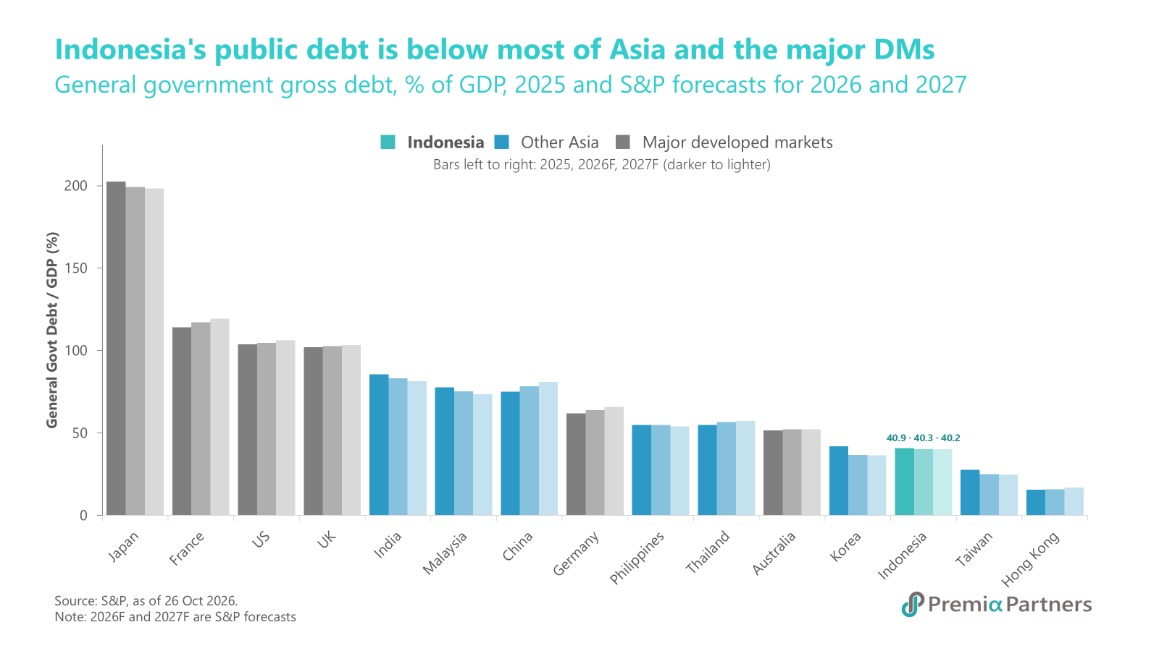
Indonesia's fiscal position is stronger than the recent sell-off implies. S&P puts general government debt at 40.9% of GDP in 2025, the third lowest of the 15 markets in the chart, and expects it to hold broadly steady at 40.3% in 2026 and 40.2% in 2027. That compares with a simple Asian average of 52.7% easing to 51.7%, and a major developed-market average of 106.0% rising to 107.6%. Japan, India, Malaysia and China all carry heavier debt loads.What rattled markets was an equity-market issue, not a fiscal one. On 15 October, MSCI proposed moving Indonesia from “Emerging Market“ to “Standalone Market“ status, citing opaque shareholding structures and suspected coordinated trading. Jakarta shares fell 11.6% in a single session, the steepest one-day drop since 1998. Indonesia government international bonds and sukuk, by contrast, barely flinched: five-year CDS widened from roughly 84–88bp in late September to around 100bp by 22 October, with part of that move predating MSCI's announcement and tracking higher US Treasury yields.Nothing has yet changed in Indonesia's index status. MSCI will consult until April 2027 and announce a final decision by 30 June 2027, leaving time for reform. Authorities have already moved, mandating a 15% minimum free float, requiring disclosure of 1% shareholdings and removing highly concentrated stocks from the JCI. Enforcement will decide the outcome, but if these measures stick, the episode could leave Indonesia with a more transparent and investable market than before.The Premia J.P. Morgan Asia Credit Investment Grade USD Bond ETF (3411 / 9411 HK) holds Indonesia as one exposure among many. The ETF spans 124 issuers across Asia ex-Japan, with Indonesia at roughly 15%: about 10% across Indonesian government bonds and sukuk, and 5% across quasi-sovereign and corporate names including Bank Mandiri, Freeport Indonesia, Indofood, Indonesia Asahan Aluminium, Minejesa Power, Pertamina and PT Perusahaan Listrik Negara - high-quality investment-grade issuers.
Oct 28, 2026