프리미아 인사이트
주요 인사이트 & 웨비나

Markets are forward looking and they follow the money Pandemics/Epidemics have had little discernible impacts on markets Hang Seng and S&P 500 rallied in the face of SARS 2002-2003 - they were focused on recovery from the Nasdaq Crash S&P 500 rallied despite devastating Swine Flu in 2009-2010 - it was more focused on recovery from the global financial crisis Even the Spanish Flu pandemic, which killed between 50 million and 100 million people, did little to drive the Dow Jones China's GDP will be dented in 1Q2020 but should recover later in the year
Jan 28, 2020
The deal is containment of conflict, not cessation of hostilities US demands against China’s subsidies for State-Owned Enterprises (SOE) and control over the Renminbi remain unresolved core issuesUS targets for Chinese purchases over the next two years are extremely ambitious and at risk of not being metChina has bought some time to reduce its technology and trade dependence on the USChinese policy makers will likely maintain a cautious monetary and fiscal policy stance to avoid a “Japanese Bubble” outcome
Jan 15, 2020
With the current risk-on sentiment, it is reasonable for investors to look for growth area in the market. Yet, which sectors in China A-shares offer higher growth in 2020 based on the consensus forecast from the sell-side analyst? It would be essential to know beforehand for investors in allocating their assets in China market. That said, does it mean that anything outside the growth segments is not worth investing? Since China has been emphasizing on quality instead of quantity under the structural change of the economy, is it probable that there could be some hidden gems in the stable or slow-growth industries? We will try to answer these questions in this article.
Jan 14, 2020
2019 saw expensive asset classes get more expensive, a global yield back-up replaced by a yield rally, continued outperformance of DM over EM and Growth over Value (notwithstanding a few wobbles). As we approach 2020, we review market behavior during the last 12 months, the risk and opportunities going forward and make a few observations about trends that will dictate returns.
Dec 08, 2019
We review the history of Chinese consumption over the last 30-40 years and explain why we believe the Chinese consumer holds the key to global economic growth, not just in China but in every country connected to international markets.
Nov 10, 2019
Investors like to conceptualize mega trends into investment themes, which fund managers use to identify strong companies based on top-down investment approaches with a focus on broader, macroeconomic themes. New investment themes always emerge from time to time, such as dot.com around the millennium, social media & robotics in the past decade, or sharing economy & artificial intelligence not long ago. What do they have in common? Technology! A sudden shift in technology would make transformative changes that redefine work processes, rewrite the rules of competitive economic advantage, and eventually the structural breakthrough will bring the potential output to the next level. That’s why market is interested to find out if 5G is a crucial investment theme.
Nov 04, 2019
“Think about what is happening worldwide right now. The US is dragging down global growth by attempting to impose trade tariffs everywhere, China is facing a major economic slowdown, Japan continues their third “lost-decade”, Germany is heading into recession, and the UK is still debating with EU about the way of Brexit. These are just the highlights of how the top five economies are doing, not even mentioning the more troublesome territories such as Italy and Argentina which may have to deal with their escalating debt problems. These markets accounted for more than 70%-80% of the global stock markets depending on which particularly benchmark one is using to measure against the performance. The issue gets more complicated when the US market, weighting over 50% in most clients’ equity portfolio, seems to be exhausted after recording the longest bull run in history whilst still hovers at all-time high. The most imminent question among investors is where to find the peace in the midst of the storm.”
Oct 21, 2019
The US-China trade dispute rumbled and concerns over global growth continued to mount in Q3. Factor-wise, Quality continued to outperform while Value is trailing, badly. Overall, the China A-shares ended roughly flat in Q3, and it was a meaningful quarter to the market with MSCI, FTSE, and S&P Dow Jones all made announcements of (further) inclusion of China A-shares into their benchmarks. Heading into Q4, we believe “Megatrends” continue to be the key investment themes and “Diversification” core to portfolio risk management. We don’t see a Value trap environment, but the comeback relies on many catalysts amid the current market uncertainties. Consolidation will happen as China rebalances to a “new normal”, and we believe Quality Growth is the best approach to capture domestic champions.
Oct 20, 2019
When over 30% of the investment-grade bonds are selling at a negative yield, the longest bull market in the US seems to be wobbling, global growth is decelerating and the two biggest economies are in a dispute over trade and technology, there is a need for most investors to anchor themselves in a stronghold to face the volatile markets. Benjamin Graham’s Intelligent Investor, often referenced as the best book on investing ever written, may be able to offer a bit of insight for us. At the end of the day, an intelligent investor is a realist who sells to optimists and buys from pessimists. The author has experience to back it up: Graham's personal losses in the 1929 crash and the Great Depression led him to perfect his investment techniques.
Oct 17, 2019
Forget about Donald Trump – this is what the markets are really worried about. Forget about the Trump Impeachment. That’s a sideshow. It will get sordid but Democrats won’t get rid of Donald Trump without the support of two-thirds of the Senate. That’s unlikely to happen, given currently available information about the President’s activities. At most, the impeachment inquiry will contribute to the political point-scoring of the 2020 Presidential Election. The greater decision facing investors now is whether they are prepared to put more money down on renewed quantitative easing in Europe and eventually the United States – a phenomena that will simultaneously feed asset markets and distort resource allocation around the world.
Oct 02, 2019
토픽별
주간 차트

Michael Ng
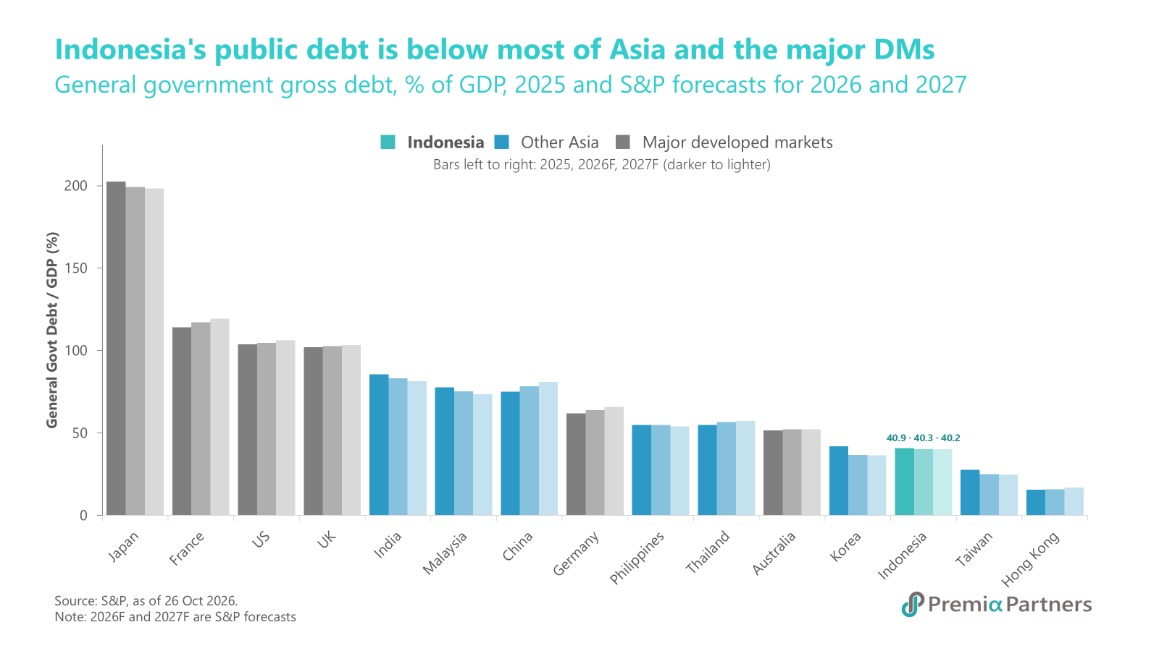
Indonesia's fiscal position is stronger than the recent sell-off implies. S&P puts general government debt at 40.9% of GDP in 2025, the third lowest of the 15 markets in the chart, and expects it to hold broadly steady at 40.3% in 2026 and 40.2% in 2027. That compares with a simple Asian average of 52.7% easing to 51.7%, and a major developed-market average of 106.0% rising to 107.6%. Japan, India, Malaysia and China all carry heavier debt loads.What rattled markets was an equity-market issue, not a fiscal one. On 15 October, MSCI proposed moving Indonesia from “Emerging Market“ to “Standalone Market“ status, citing opaque shareholding structures and suspected coordinated trading. Jakarta shares fell 11.6% in a single session, the steepest one-day drop since 1998. Indonesia government international bonds and sukuk, by contrast, barely flinched: five-year CDS widened from roughly 84–88bp in late September to around 100bp by 22 October, with part of that move predating MSCI's announcement and tracking higher US Treasury yields.Nothing has yet changed in Indonesia's index status. MSCI will consult until April 2027 and announce a final decision by 30 June 2027, leaving time for reform. Authorities have already moved, mandating a 15% minimum free float, requiring disclosure of 1% shareholdings and removing highly concentrated stocks from the JCI. Enforcement will decide the outcome, but if these measures stick, the episode could leave Indonesia with a more transparent and investable market than before.The Premia J.P. Morgan Asia Credit Investment Grade USD Bond ETF (3411 / 9411 HK) holds Indonesia as one exposure among many. The ETF spans 124 issuers across Asia ex-Japan, with Indonesia at roughly 15%: about 10% across Indonesian government bonds and sukuk, and 5% across quasi-sovereign and corporate names including Bank Mandiri, Freeport Indonesia, Indofood, Indonesia Asahan Aluminium, Minejesa Power, Pertamina and PT Perusahaan Listrik Negara - high-quality investment-grade issuers.
Oct 28, 2026