Premia 观点洞察
精选观点 & Webinar

As Iran conflicts closed off the Strait of Hormuz and sparked the ongoing oil price shock, global equity saw abrupt drawdown in Q1 as geopolitically anxious investors turned risk-off and quickly adjusted portfolios. Amidst that heightened volatility, contrary to broad market correction across both onshore and offshore Chinese equities, the Premia China Bedrock Economy strategy flourished, while the Premia China New Economy and Premia China STAR50 managed to get through the quarter nearly unscathed and remain well-positioned for policy tailwinds and hard tech structural growth as the 15th Five-Year Plan kickstarted. In this article, Dr. Phillip Wool, Global Head of Research of Rayliant Global Advisors, discusses about the macro and factor-level backdrop of China A share performance in Q1 2026, and drivers for continued optimism for onshore equities this year.
May 11, 2026

With US technology stocks under pressure from high valuations and risk-off sentiment from high beta trades amid heightened global market volatilities given geopolitical tensions, China advanced tech sector offers a well-supported and timely alternative for investors looking to diversify. The numbers speak for themselves: over the past two years, the hardcore technology focused STAR50 Index gained 77.3%, comfortably ahead of the Nasdaq's 40.2%. China has put innovation at the core of its long-term growth plan, with strong government backing for AI, semiconductors, and advanced manufacturing. Under Beijing’s domestic substitution policy, Chinese companies are rapidly replacing foreign technology with homegrown solutions, and earnings forecasts are being revised higher. In this article, our Partner & Co-CIO David Lai discusses the policy signals emerging from China's 15th Five-Year Plan and explores how investors can tap into these opportunities through our Premia China STAR50 (3151 / 9151 / 83151 HK) for focused exposure to China's leading hardcore technology companies, as well as our Premia China New Economy (3173 / 9173 HK) that provides broader coverage across nearly 300 holdings spanning the full new economy landscape.
Apr 07, 2026

Last December China launched a major national venture capital fund, a national guidance fund and three large regional funds (Beijing-Tianjin-Hebei, Yangtze River Delta, Greater Bay Area), all designed to channel billions of development capital into "hard technology" sectors like semiconductors, AI, and biomedicine to fast track its trajectory to overcome the current choke points and achieve technology independence amid persistent geopolitical tension. Meanwhile, Bloomberg reported that China is also considering a US$70 billion package of incentives to boost its semiconductor industry. These are only the latest in a string of boosters: China had already announced numerous measures over the past two years, estimated to value almost US$100billion, to lift capabilities in its chip sector. In this article, we reviewed China's ongoing efforts in the global chip race, and how under rapid acceleration in domestic substitution across cutting-edge logic chips, memory foundries, and AI models, our China New Economy (3173 / 9173 HK) and China STAR50 (3151 / 9151 / 83151 HK) strategies are uniquely positioned to capture these structural opportunities.
Apr 07, 2026

Despite last year’s pronounced rally in onshore Chinese stocks, the fourth quarter saw strong rotation from growth plays to a value theme, leading to divergence in the Bedrock and New Economy strategies over the final few months of the year. That said, we note all three of the Premia China ETFs showed marked outperformance over broad market, as investors continued to pivot to hardcore technology and strategic new economy sectors notwithstanding profit taking and risk-off sentiments towards the year end. In fact, under strong tailwinds such as domestic substitution policies, China’s economic engine is being reconfigured as many of these emerging leaders started to show fast tracked earnings growth and profitability. With this background, CSI Caixin Rayliant New Economic Engine Index (tracked by Premia China New Economy ETF - 3173 / 9173 HK ETFs) outperformed CSI300 solidly with total gain of 23.9% for full-year 2025, while China STAR50 index (tracked by Premia STAR50 ETF - 3151 / 9151 / 83151 HK ETFs) delivered even stronger full-year return of 36.5% notwithstanding the end of year profit taking. Meanwhile, as Low Risk, Value, Quality factors advanced in Q4, as a defensive strategy in risk off environment CSI Caixin Rayliant Bedrock Economy Index (tracked by Premia China Bedrock Economy ETF - 2803 / 9803 HK ETFs) outperformed the broader market with a gain of 4.9% for the quarter, bringing its full-year return to 12.6%. In this article, Dr. Phillip Wool, Global Head of Research of Rayliant Global Advisors, discussed the macro and factor-level influences, and provided a concise summary of contributors to China A share performance in Q4 2025 and possibly into 2026 as we kick start the first year of the 15th Five Year Plan.
Mar 15, 2026

With many of the global leading high tech manufacturing players, the Taiwan stock market sits at the confluence of the global tech super cycle, robust earnings growth and modest valuations, and is home to many global leading Asian technology players. The fundamental tailwinds that drove the Taiwanese stock market’s outperformance from 4Q25 are likely to continue carrying the rally in 2026. Indeed, the Taiwan market appears to be in the early stages of its outperformance cycle. In this article, our Senior Advisor Say Boon Lim explores why in addition to TSMC, the blue chip cohort from Taiwan offers global investors a unique diversification opportunity, providing exposure to technology super cycle beyond US big tech names, complemented by its attractive valuations and low correlations with other major asset classes.
Feb 01, 2026

Analysts including JP Morgan, Goldman Sachs, Morgan Stanley, HSBC, and Standard Chartered are generally bullish on Emerging Markets (EM) for 2026, citing dollar weakness, AI growth, and affordable valuations. Within EM, EM ASEAN is an under-appreciated sweet spot that blends value, yield and structural upsides. In this article, our Senior Advisor Say Boon Lim discusses how the region transitions towards more domestically-driven growth, with macro tailwinds from significant foreign direct investments, public infrastructure spending, and robust exports fuelled by AI demand and global supply chain dynamics.
Jan 18, 2026

As markets enter 2026, the need for diversification has gained an urgency not seen since possibly at the peak of the Nasdaq Bubble in year 2000. Both US stocks and corporate credits are priced for perfection in an economy that has been held up by stretched fiscal and monetary stimulus. The sales pitch of “American exceptionalism” may be wearing thin. US Big Tech is overpriced and may have overinvested in AI. Meanwhile, the labour and consumer markets are weakening even while inflation remains stubborn. The long-end of the Treasury yield curve has started ignoring rate cuts – a sign of concern about the sustainability of US government debt. In this article, our Senior Advisor Say Boon Lim discusses the urgency of diversification away from US-overpriced assets, while China and emerging ASEAN markets present compelling complementary attributes for diversified multi-asset portfolios.
Jan 12, 2026

China approaches 2026 on a firmer economic and market footing, supported by clearer policy direction and a maturing innovation ecosystem. While growth may ease slightly from recent levels, structural themes—ranging from advanced manufacturing upgrades to measures addressing excess capacity—are set to shape the early phase of the 15th Five-Year Plan. Domestic investors are gradually shifting from deposits toward higher-return financial assets, adding resilience to onshore markets. In fixed income, moderating yields and strengthening demand for RMB-denominated assets create a more constructive backdrop for China government bonds. In this article, our Partner & Co-CIO David Lai discusses how these developments foster a more stable and attractive investment landscape, offering compelling opportunities to express China exposure across both equities and fixed income.
Jan 12, 2026

AI was the common theme for growth across markets last year. S&P500 and Nasdaq delivered +17% and 21% respectively in USD terms for FY2025, while China broad market (CSI300) rallied 21%, and China tech outperformed with +46%, Asia tech was up +45% and Taiwan stock market gained +40%. Going into 2026, few would dispute drivers for stock market performance would continue to be innovation-led opportunities. In this article, we discuss tailwinds from the hardcore tech especially AI infrastructure, semiconductor, robotics, and biotechnology, where technological breakthroughs, accelerated commercialization and improved earnings growth and profitability support further re-rating actions ahead. This is where our Premia China STAR50 ETF and Premia China New Economy ETF focus on, and would serve as efficient and optimized vehicles to provide direct access to the leading beneficiaries that are poised to define China's economic trajectory in 2026.
Jan 12, 2026

Following a historic breakout in 2025, the Premia Vietnam ETF rallied a stunning 73% (total return in USD NAV) in 2025, while the broad market also rallied 39%. The market is now transitioning from recovery in sentiment to a phase of progressive policy execution, including the "Doi Moi 2.0" reforms (Resolution 68). These reforms offer unprecedented policy support for the private sector. And the mandate to nurture 20 globally competitive large private firms provide strong cases for revaluation opportunities for large cap leaders. In this article, we will explore why Vietnam remains a compelling market in 2026 amidst imminent FTSE Emerging Market upgrade. Our Premia Vietnam ETF—with its focus on private sector champions and Small-Mid caps—is distinctively positioned to capture the specific beneficiaries of these structural shifts.
Jan 12, 2026
Premia 图说

吴伟锋
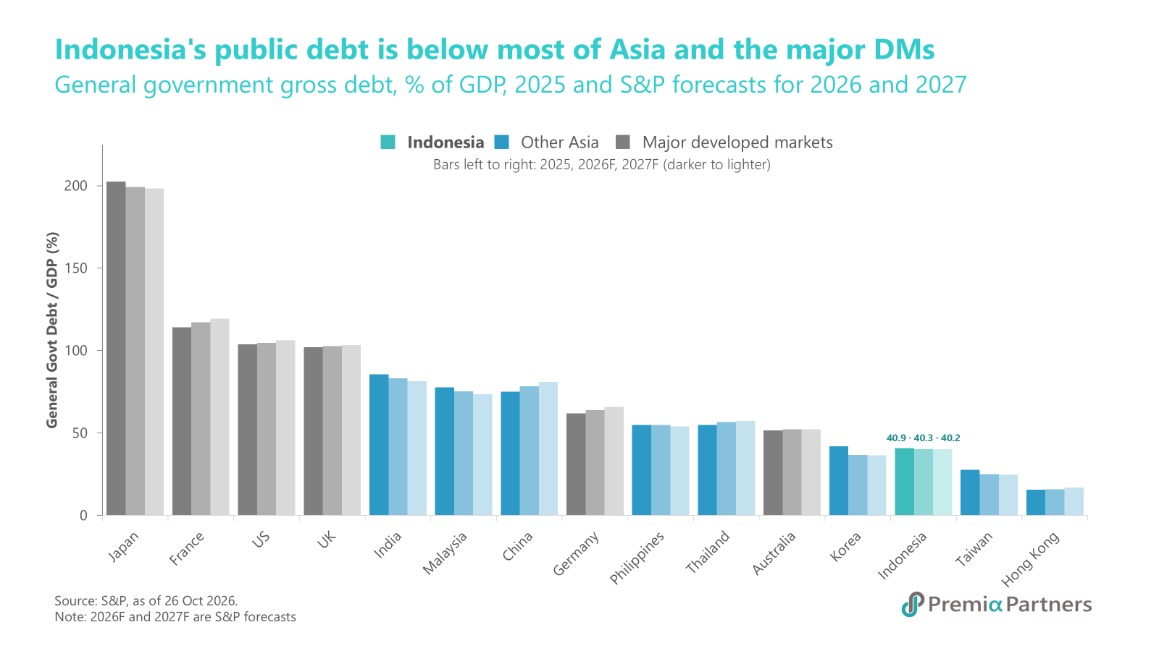
Indonesia's fiscal position is stronger than the recent sell-off implies. S&P puts general government debt at 40.9% of GDP in 2025, the third lowest of the 15 markets in the chart, and expects it to hold broadly steady at 40.3% in 2026 and 40.2% in 2027. That compares with a simple Asian average of 52.7% easing to 51.7%, and a major developed-market average of 106.0% rising to 107.6%. Japan, India, Malaysia and China all carry heavier debt loads.What rattled markets was an equity-market issue, not a fiscal one. On 15 October, MSCI proposed moving Indonesia from “Emerging Market“ to “Standalone Market“ status, citing opaque shareholding structures and suspected coordinated trading. Jakarta shares fell 11.6% in a single session, the steepest one-day drop since 1998. Indonesia government international bonds and sukuk, by contrast, barely flinched: five-year CDS widened from roughly 84–88bp in late September to around 100bp by 22 October, with part of that move predating MSCI's announcement and tracking higher US Treasury yields.Nothing has yet changed in Indonesia's index status. MSCI will consult until April 2027 and announce a final decision by 30 June 2027, leaving time for reform. Authorities have already moved, mandating a 15% minimum free float, requiring disclosure of 1% shareholdings and removing highly concentrated stocks from the JCI. Enforcement will decide the outcome, but if these measures stick, the episode could leave Indonesia with a more transparent and investable market than before.The Premia J.P. Morgan Asia Credit Investment Grade USD Bond ETF (3411 / 9411 HK) holds Indonesia as one exposure among many. The ETF spans 124 issuers across Asia ex-Japan, with Indonesia at roughly 15%: about 10% across Indonesian government bonds and sukuk, and 5% across quasi-sovereign and corporate names including Bank Mandiri, Freeport Indonesia, Indofood, Indonesia Asahan Aluminium, Minejesa Power, Pertamina and PT Perusahaan Listrik Negara - high-quality investment-grade issuers.
Oct 28, 2026