주요 인사이트 & 웨비나

Consumer spending in China continues to grow strongly by international standards, even as the pattern of that spending evolves. The image of weak consumerism in China – as portrayed by the media – is misleading in two ways. For starters, the growth in retail sales in China is only “low” relative to the very high (mostly double digit) rates recorded in the 2010s. However, at 7.2% y/y growth in the full year 2023, China’s retail sales growth compares very well internationally. Beyond that, there are also changing social trends which are driving different forms of consumption in China, which then support investments that are more reflective of the transformation in China. In this article, we discuss more about how young Chinese are the main driving force in China’s consumer market and identify the winners of this quiet but significant sea change in consumer behaviour.
Mar 01, 2024

Extremely negative sentiment culminating Q4 2023 toward Chinese stocks have brought A shares to exceedingly low valuations for an economy with so much inherent growth potential, that it would appear the upside risks far outweigh the downside risks at this point. Meanwhile we see differentiating features of the bedrock and new economy indices including factors tilting toward bargain stocks and high-quality growth at a reasonable price, along with a concentration in strategic sectors that truly drive China’s real economy. In this article, Dr. Phillip Wool, Global Head of Research of Rayliant Global Advisors reviews the factor performance of the onshore A-shares markets in Q4 2023, and reasons why investors may look back at 2024 as a turning point for China’s equity markets, and outstanding entry point for a vintage well positioned for growth recovery in the new normal.
Feb 23, 2024

There is a big disconnect between the image of the Chinese economy portrayed by the media and the underlying data. As we start the year, we review key pieces of data from both China and the US. In summary, while the data for China has not been as good as the market may have liked, it was better than what the media would have had us believe. A quick run through the China data for the first nine months of the year, as collated by “China Briefing”: Growth in real GDP 5.2%; industry output 4.0%; services output 6.0%; retail sales 6.8%; fixed asset investment 3.1%. These are very decent growth figures by any international comparison. And China achieved the above figures with a smaller fiscal deficit than the US and while bearing the burden of rebalancing growth away from dependence on the property sector.
Jan 15, 2024

Global markets have hit extremes in sentiment – extreme exuberance towards the US and Japan and extreme pessimism about China. That sentiment has in part been driven by straight line projections of the cycle – the expectation that the US will continue its current path towards “Goldilocks” and Japan can sustain its currency depreciation-led earnings growth. The risks are that the cycle in the US transitions not to “Goldilocks” but to recession, and Japan’s Yen depreciation/reflation cycle cannot be sustained without dangerous inflation and ultimately government debt consequences. For China, the extreme in pessimism is predicated on the assumption that China cannot escape its cyclical weakness of the last 12 months, notwithstanding its ample policy “ammunition”.
Dec 18, 2023

Investors should expect a better return in Chinese equities in 2024 after three consecutive negative yearly return. Indeed, it is the first time that China stock market has recorded an annual loss three times in a row. Slowing economy, heighted China-US bilateral relationship, strong dollar and property market slump all contributed to the disappointing performance in the past twelve months. Looking ahead, the market may offer more upside risks because of (1) stronger supportive policies rolling out to help lift economic activities and particularly the property sector, (2) geopolitical tensions tuning down with increasing dialogues between Chinese and US top government officials, (3) domestic long-term investors’ buying and foreign investors’ current significantly underweight position in Chinese equities, and (4) value emerging from the discounted share prices on both absolute and relative basis. Bamboo is a symbol of longevity in China because of its durability, strength, flexibility, and resilience. It survives in the harshest conditions, persevere and still standing tall and staying green year-round. When the storm comes, bamboo bends with the wind. With business and consumer confidence continue to recover amid the much more accommodating, easing environment, Chinese entrepreneurs and the equities market should finally be in for a year of promising growth ahead.
Dec 18, 2023

Emerging ASEAN is one of the most compelling investment stories of 2024 – offering what is now an uncommon combination of growth and undervaluation. Having come to the end of its rate hiking cycle, with economic growth very much intact, Emerging ASEAN now benefits from tailwinds from a cyclical transition to stimulus amidst solid structural growth fundamentals. Vietnam in particular moved early and decisively in 2023 towards stimulus and its market is now favourably positioned with a PE to 2-year earnings CAGR ratio of only 0.36. In this article our Senior Advisor Say Boon Lim and Portfolio Manager Alex Chu discuss more about the fundamental growth drivers for this under-covered region, and how the end of the US rate hike cycle and the current valuation offer attractive opportunities for global and emerging markets allocators looking for uncorrelated alpha.
Dec 18, 2023

While many other economies have bounced back to trend growth, the latest IMF forecast shows that collectively the Emerging ASEAN-5 will likely have the strongest growth outlook among the major market/regional groupings. The IMF forecasts suggest that Emerging ASEAN-5 will likely grow its collective nominal GDP by 56% between 2022 and 2028, and will grow its nominal GDP from 72% of Japan’s GDP in 2022 to 92% by 2028. Their expected gain will be way ahead of those estimated for the Developed Market economies of the US, Euro Area and Japan. In this article, our Senior Advisor Say Boon Lim discusses the growth trajectory and drivers for opportunities in ASEAN, and why ASEAN is well placed to gain alpha while US is entering its final phase of the rate hike cycle.
Nov 20, 2023

Surging Treasury yields and increasing anxiety over the Fed’s ‘higher for longer’ policy led global equities to ‘risk-off’ in the third quarter, though the challenge for Chinese stocks in the CSI 300 Index, down -2.9% for the quarter, remained mostly a function of negative sentiment toward China’s property market and skepticism that policymakers were doing enough to put the nation’s economic recovery back on track. Nevertheless, we saw some very positive signs in Q3, with Beijing beginning to implement targeted stimulus that, by quarter end, already appears to be bearing fruit. From a factor perspective, the new economy portfolio’s quality growth exposure is effectively levered to the upside surprises we see as significantly undervalued at this moment, while the bedrock index should continue to benefit from value and quality exposures, allowing us to identify true bargains poised for revaluation. In this article, Dr. Phillip Wool, Global Head of Research of Rayliant Global Advisors, discusses third-quarter performance and outline our expectations for China’s economy and market as 2023 draws to a close.
Nov 06, 2023

Bloomberg reported that Chinese policymakers, led by the Ministry of Finance and the National Development and Reform Commission, are planning to launch a new round of stimulus, involving a potential issuance of at least RMB 1 trillion of additional China government bonds and an upward revision of fiscal budget deficit. Some investors may be worried about its negative impact on the bond market with the potential jump in supply. In this article, our Partner & Co-CIO David Lai discusses why we agree with most analysts that it would not create any lasting impact even if the plan materializes. In fact, China remains disciplined in fiscal policy whilst the overall monetary stance stays accommodative. China government bonds have outperformed almost all other sovereign bonds this year due to the rate cuts and low inflation expectations. The long end of China yield curve in particular benefited the most year-to-date, with the yields on 10-year, 30-year, and 50-year having fallen 13.8bps, 18.0bps, and 20.2bps respectively already.
Oct 19, 2023

From “Goldilocks” to “Nightmare on Wall Street” – the convergence of structural and cyclical forces looks set to inflict a lot more damage on US assets. For some time now, we had been warning about the upside risks to US Treasury yields. That slow, upward creep in US Treasury yields recently turned into a rampage, with nasty implications for both US bonds and equities. Meanwhile structural factors are further feeding the rise in UST yields – more supply, less demand. In this article, our Senior Advisor Say Boon Lim discusses about the great refinancing pressure of US government debt looming, how a lot of stuff could “break” if funding costs keep going up – including US banks – and how things may play out if the structural factors are dominant, a cyclical economic downturn may not necessarily bring down funding costs.
Oct 19, 2023
토픽별
주간 차트

Michael Ng
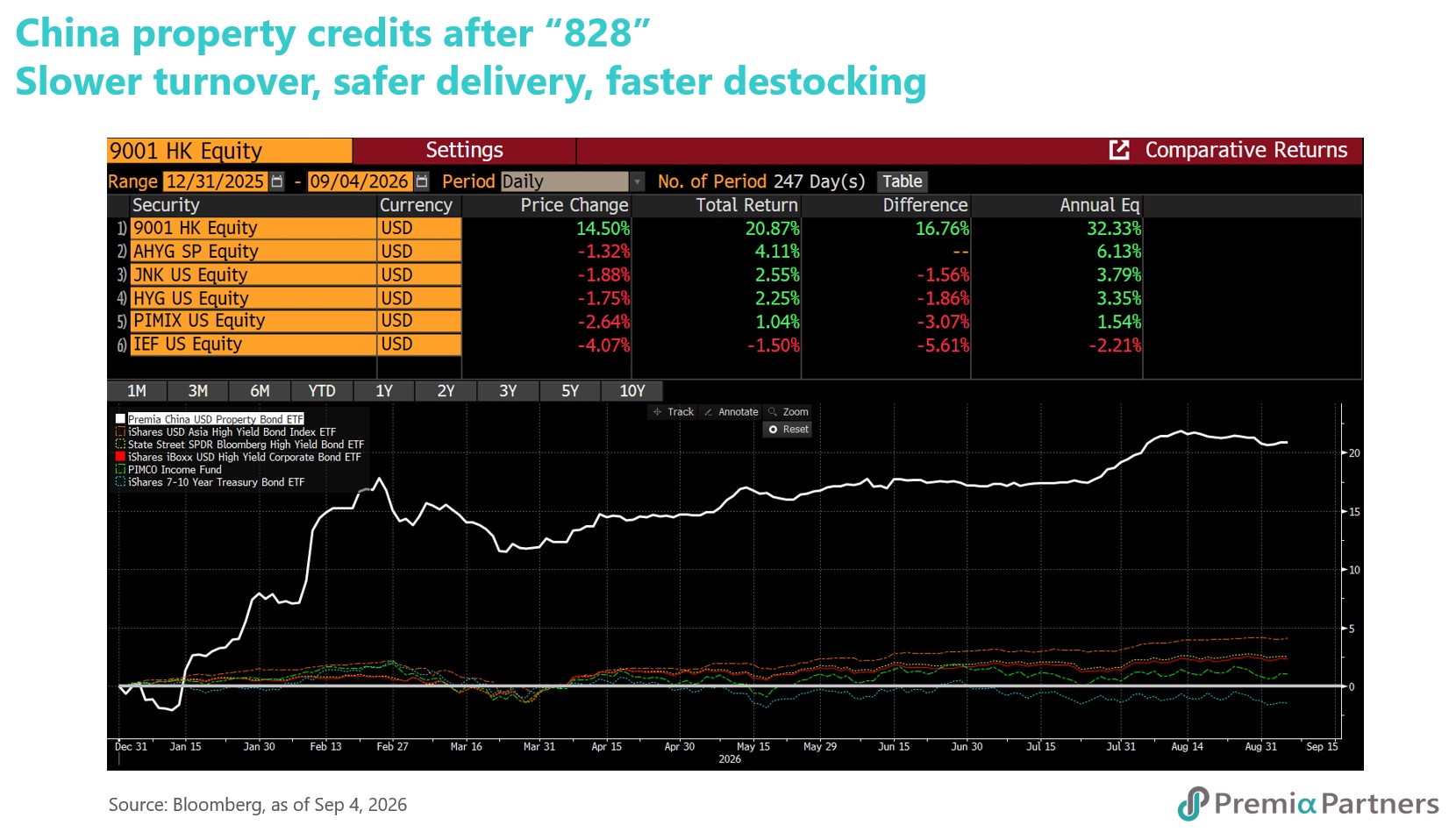
China property USD bonds have extended gains through the third quarter, with the Premia China USD Property Bond ETF (3001/9001 HK) up more than 20% year to date. On 28 August, Beijing announced the most significant overhaul of China's housing sales and financing framework in three decades. It works through four channels:Sales milestones reset. MOHURD, MNR and NFRA now require a building to be structurally topped out before presales can begin, with 100% of purchase funds — down payments and mortgage proceeds — held in supervised escrow until completion and delivery.Lead-bank oversight. Designated banks supervise project financing, escrow and construction progress end to end, and a homebuyer's mortgage is now issued only after the project is completed.Longer mortgage tenors. The PBOC lifted the maximum personal mortgage tenor from 30 to 40 years.Wider capital-market access. The CSRC broadened refinancing and M&A channels, alongside expanded REIT, CMBS and ABS support for income-producing assets.While the near-term read is negative for developers - replacing presale proceeds with borrowing implies higher leverage and more secured debt, which can subordinate existing senior claims - that argues for selection rather than avoidance. The Premia China USD Property Bond ETF (3001 / 9001 HK) holds secured and senior unsecured paper only, and excludes subordinated debt and LGFVs, favouring issuers with recurring rental income and the securitisation access the CSRC has just widened. Over the medium to long term, the reform should reduce the risk of another property-sector shock. Delivery risk moves off household prepayments and into bank-supervised project finance, lowering the odds of a repeat of the unfinished-project stress that drove the last default wave, while tighter new-home supply supports the clearing of existing inventory. Meanwhile, banks are being capitalised to carry that risk: Beijing announced a further RMB360bn (US$54bn) injection into eight state financial institutions on 6 September, of which RMB290bn (US$43.2bn) went to lenders. Brokers expect developer equities to stay soft unless policy surprises or sales data improve. Bonds answer a different question: not whether growth returns, but whether issuers keep paying. The ETF yields around 12.9% (as of Sep 8, 2026), well above the broader Asia high yield market - the extra income investors are paid for the risk that some issuers still restructure or default while the transition plays out.
Sep 10, 2026